Navigating the Eurasian Steppe: Conservationists Fight to Protect Ancient Saiga Antelope Migration Corridors Amid Rapid Industrialization

The remote steppes of western Kazakhstan present an unforgiving landscape where seasonal rains rapidly transform grasslands into treacherous sludge, and sudden Siberian storms coat the earth in layers of blinding ice. It was across this stark, treeless expanse that a field audit team from the Association for the Conservation of Biodiversity of Kazakhstan (ACBK) navigated a mud-choked trail to monitor one of the planet’s most resilient yet vulnerable ungulates: the saiga antelope.
For conservationists Alexandr and Albert, who boast a combined twenty-five years of field experience tracking saigas, these winter audits are critical. The timing of their latest expedition coincided directly with the saigas’ annual rutting season—a crucial biological window characterized by massive, single-file migrations, competitive displays of physical prowess, and complex mating rituals that determine the genetic future of the herds.
Evolutionary Survivors of the Ice Age
The saiga antelope (Saiga tatarica) is a living relic of the Pleistocene epoch. Sharing the prehistoric landscape with woolly mammoths, saber-toothed cats, and giant deer sporting twelve-foot antlers, saigas successfully outlived the vast majority of Ice Age megafauna. For millennia, these nomads of the semidesert have relied on their unique physiological adaptations to endure extreme environmental pressures.
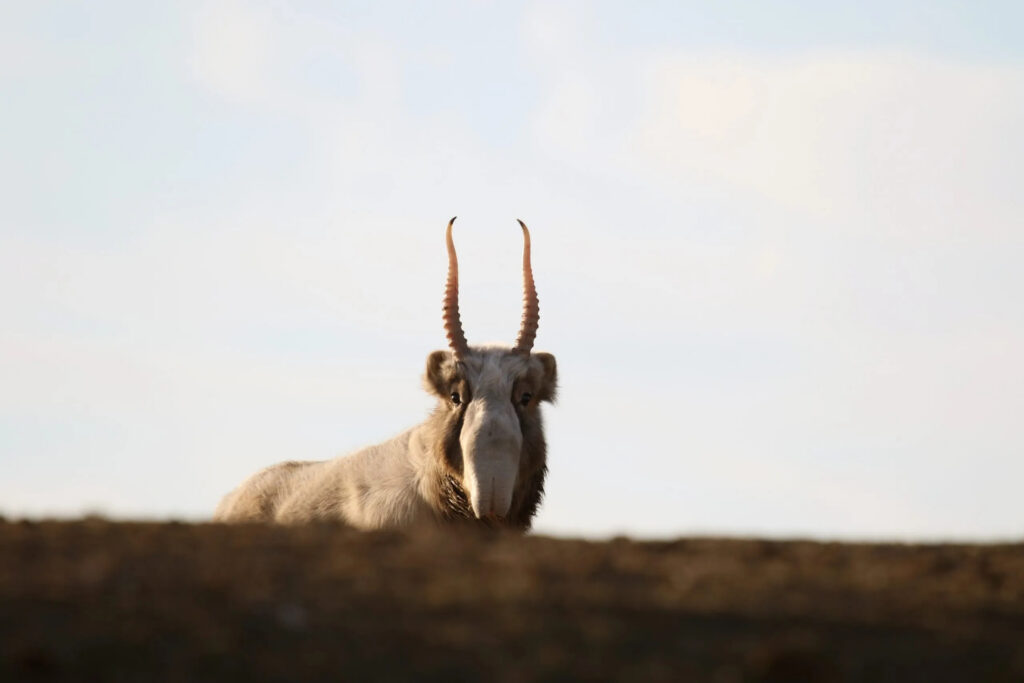
Among their most striking physical features is the saiga’s distinctive, elongated, and floppy snout. During the blistering summer months, this specialized proboscis functions as a biological filter, keeping choking dust out of the animal’s respiratory system. In the bitter winter, the nasal cavity warms frigid, sub-zero air before it reaches the lungs. During the rutting season, a large, pronounced nose serves as the ultimate indicator of male virility and fitness. Female saigas actively assess potential mates based on these olfactory traits, prompting males to engage in aggressive headbutting and strutting displays that often push them to the brink of physical exhaustion.
Historically, saigas were so ubiquitous across the Eurasian steppe—ranging from the Caucasus Mountains to Mongolia—that early human caravans relied upon them as natural guides through treacherous terrain. However, the rise of human infrastructure has drastically altered this ancient dynamic.
Infrastructural Fragmentation and the Collapse of Spatial Knowledge
The historical migratory routes of the saiga antelope spanned thousands of miles across Central Asia. Today, however, these sweeping journeys face unprecedented interruptions. Following the dissolution of traditional nomadic human societies—largely accelerated by Soviet-era sedentarization policies in the 20th century—the Eurasian steppe experienced a surge in industrial development.
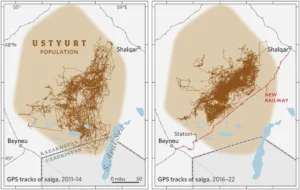
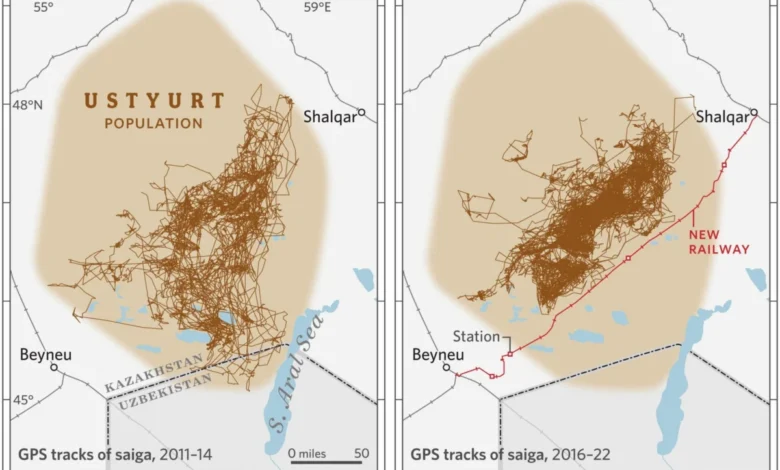
The rapid construction of roads, highways, and electrified railways has systematically fragmented the landscape. Data collected via GPS collars deployed by ACBK researchers illustrate the devastating immediate impacts of linear infrastructure on wildlife movement. In a striking example highlighted by ACBK, a population of saigas that routinely migrated deep into Uzbekistan was abruptly cut off by the construction of a new railway line in 2014. Telemetry data from preceding years showed high concentrations of animals crossing the region seasonally. Post-construction data revealed a tragic behavioral shift: the collared animals were recorded pacing despondently on the northern side of the tracks, completely blocked from the historic grazing lands and water sources situated to the south.
This artificial severing of migration corridors triggers a phenomenon conservation scientists compare to the erasure of a language. Much like human populations forced into sedentary agricultural plots, young saigas acquire spatial knowledge—including reliable routes to food, seasonal shelter, and predator avoidance—through social learning and active participation in herd migrations. When barriers partition their historic home ranges, entire generations lose ancestral knowledge, leading to population declines and localized extinctions.
Collaborative Mitigation and Cross-Border Conservation Efforts
Recognizing the existential threat posed by habitat fragmentation, ACBK has partnered closely with the government of Kazakhstan and neighboring nations to implement targeted mitigation strategies.
Recent conservation interventions include the establishment of new wildlife sanctuaries informed by empirical tracking data. Furthermore, conservationists have engineered specialized saiga-friendly crossings along major transportation corridors. These infrastructure projects feature gently sloping dirt ramps designed to match the elevation of railway tracks, creating the optical illusion of a natural break in the barrier. Strategically placed cattle-guard fences situated at a distance from these crossings ensure that high-speed trains and migrating herds do not intersect, thereby preserving the safety of both wildlife and rail transit.
International cooperation has also yielded positive results at state boundaries. ACBK recently collaborated with Uzbek authorities to modify traditional barbed-wire border fences. By replacing solid barriers with X-shaped barricades, officials successfully blocked unauthorized vehicular access while leaving precise clearance intervals that allow saigas to cross unimpeded.
Broader Implications for Steppe Ecology and Human History
The plight of the saiga antelope is inextricably linked to the cultural and ecological history of the region. The western corner of Kazakhstan, bordered by the fertile banks of the Ural River, has served as a vital transcontinental crossroads since the Early Iron Age. The Ural River functions as the natural geographic boundary between Europe and Asia, marking a historic convergence point where ancient trade routes, including the Silk Road, flourished.
Historians note that early human transit corridors were heavily influenced by the seasonal migrations of wildlife, including saigas. The disruption of these natural pathways not only threatens biodiversity but also erases a foundational chapter of Eurasian ecological history.
Despite the mounting pressures of human development, recent population surveys indicate that targeted anti-poaching measures and habitat management have allowed certain saiga herds to experience cautious population rebounds. However, experts emphasize that long-term survival depends entirely on maintaining ecological connectivity across borders.
As Alexandr, Albert, and the ACBK team continue their field audits across the snow-covered expanse of the western steppe, thousands of saigas continue to traverse the landscape, their hooves marking the frozen earth. Ensuring that these ancient pathways remain open is no longer just a matter of wildlife management—it is a race to preserve one of the earth’s last truly untamed migrations before the modern world closes in entirely.