The Ultimate Guide to Berlin Christmas Markets: Navigating the German Capital During the Festive Season

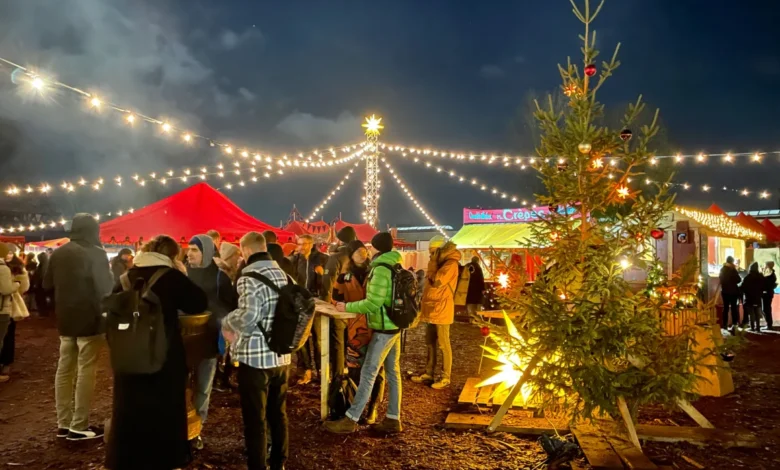
As the winter solstice approaches and daylight hours in the German capital dwindle, Berlin undergoes a seasonal transformation defined by the warm glow of festive illumination and the scent of spiced mulled wine. Unlike many European municipalities where holiday celebrations center around a single municipal square, Berlin approaches the Advent season on a decentralized scale. The city hosts approximately 70 distinct Christmas markets, known locally as Weihnachtsmärkte or Adventsmärkte, distributed across its various neighborhoods. This decentralized network reflects the city’s complex urban geography, offering visitors a wide spectrum of experiences ranging from traditional imperial pageantry to alternative, community-driven winter festivals.
Historical Context and Evolution of Berlin’s Holiday Markets
The tradition of the German Christmas market traces its roots back to the Late Middle Ages, initially serving as localized trading events where citizens could purchase essential supplies, meat, and winter goods before the onset of severe weather. While cities such as Nuremberg, Munich, and Stuttgart have historically dominated international recognition for their centuries-old markets, Berlin’s holiday landscape has evolved distinctively. Because the German capital historically lacked a singular, unified city center due to its geopolitical division and sprawling urban layout, its holiday markets naturally developed as neighborhood-specific hubs.

Over the past two decades, the scale of Berlin’s winter celebrations has expanded significantly. City tourism boards and local district offices have increasingly recognized the economic and cultural impact of the Advent season, which draws hundreds of thousands of domestic and international travelers annually. Despite this commercial growth, the core function of the Berlin Christmas market remains anchored in social cohesion—serving as an after-work meeting place for colleagues, a weekend gathering space for families, and a communal defense against the psychological toll of the dark, cold winter months.
Chronology and Operational Windows

The Berlin Christmas market season operates within a tightly regulated timeframe dictated by the Christian liturgical calendar of Advent, typically commencing in late November and concluding either immediately before Christmas Day or extending through the New Year.
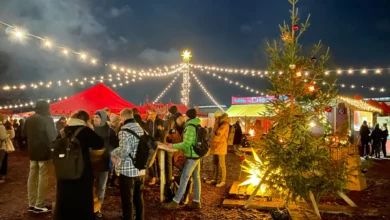
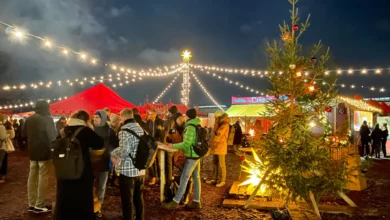
For the current season, the vast majority of Berlin’s markets open their gates on Monday, November 25. While major daily markets operate continuously through December 23 or 31, a significant portion of the city’s most authentic venues operate strictly on a weekend-only basis. Because winter sunsets in Berlin occur prior to 4:00 PM throughout December, municipal authorities and market operators emphasize evening hours—roughly between 4:00 PM and 9:00 PM—as the optimal window for attendance, when architectural illuminations and decorative lighting reach peak aesthetic effect.

Prominent Fixed Markets: Tradition and Architectural Backdrops
Among the dozens of daily options operating throughout the Advent period, several locations have established themselves as benchmarks for scale, historical architecture, and specialized craftsmanship.

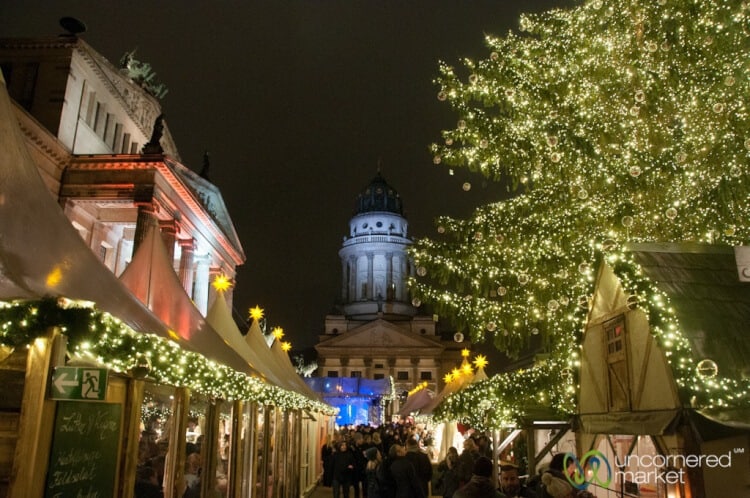
The WeihnachtsZauber at Gendarmenmarkt is frequently cited as one of the city’s most visually striking daily markets. Situated between the architectural pairing of the Deutscher Dom and Französischer Dom, alongside the historic Konzerthaus, this market places a heavy emphasis on high-end handicrafts, fine art, and gourmet gastronomy. Operating under a nominal admission fee—historically set at one euro—the market restricts commercial schlock in favor of artisans, woodcarvers, and international culinary vendors. Visitors frequenting the Gendarmenmarkt typically seek out specialized warming beverages such as Feuerzangenbowle, a traditional German alcoholic drink where a rum-soaked sugarloaf is set on fire and allowed to drip into mulled wine.
A similarly grand architectural setting is found at the Schloss Charlottenburg Christmas Market. Flanking the grounds of Berlin’s largest surviving royal palace—a 300-year-old Baroque residence—this market combines fairytale aesthetics with large-scale festive infrastructure, including traditional multi-tiered Christmas pyramids and nightly light projections cast against the palace façade.
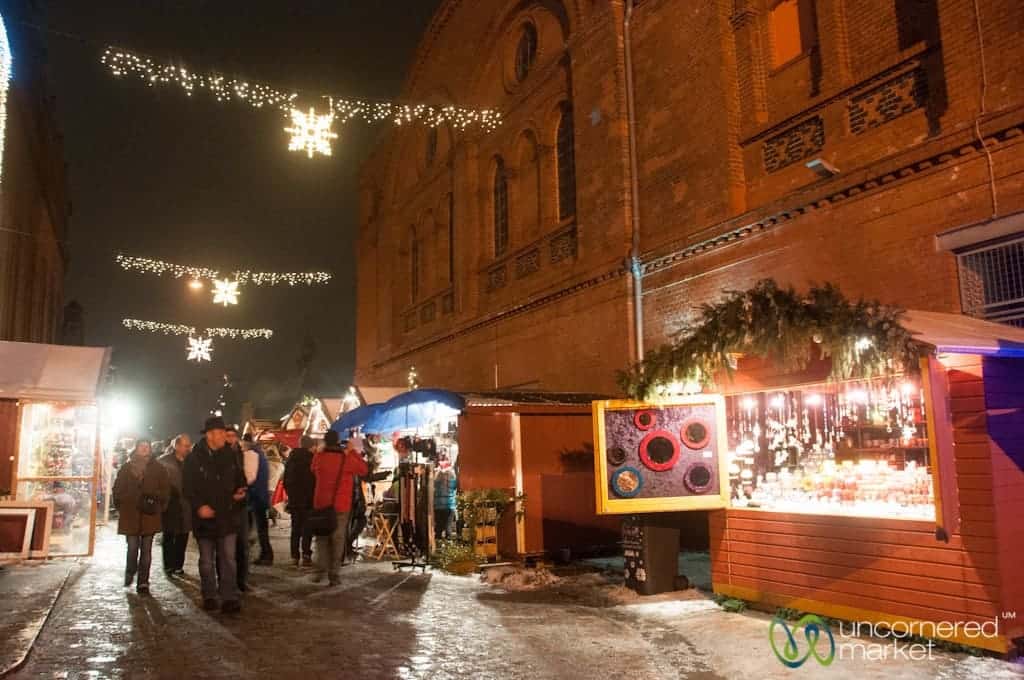
For travelers seeking a departure from traditional German motifs, the Lucia Christmas Market at the Kulturbrauerei in Prenzlauer Berg offers a distinctly Nordic and Scandinavian experience. Housed within the winding courtyards of a 19th-century industrial brick brewery complex, the market specializes in regional products from Sweden, Norway, Denmark, and Finland. Offerings include variations of Scandinavian mulled wine known as glögg, reindeer sausage, and specialized artisan goods, providing a cultural divergence from standard domestic offerings.
Neighborhood, Weekend, and Themed Markets

Beyond the prominent daily installations, Berlin’s true character is frequently observed in its hyper-local, weekend-only, and thematic markets. These installations often emphasize community fundraising, historical reenactment, or subcultural integration.
The Alt-Rixdorfer Christmas Market, held annually on Richardplatz in the Neukölln district, serves as a prominent example of a successful neighborhood-scale operation. Operating for a single Advent weekend, the market is organized almost entirely by local charities, schools, and civic groups. Revenue generated from the sale of homemade crafts and regional foods is funneled directly back into community projects, fire brigades, and social services. The historical village setting of old Rixdorf, complete with pony rides and petting enclosures, preserves a village atmosphere within the urban expanse.

Similarly, the Schloss Britz Christmas Market, also located in Neukölln, utilizes the courtyard of an 18th-century manor house to host a Nordic-medieval themed fair. Featuring a modest admission fee, the market limits commercial crowding, allowing visitors direct engagement with artisans demonstrating traditional crafts, metalwork, and preservation techniques.
For an alternative urban atmosphere, the Heissa Holzmarkt winter festival occupies a permanent cultural and artistic enclave along the Spree River in Friedrichshain. Operating on weekends during Advent, Holzmarkt merges traditional winter elements—such as riverside bonfires and mulled wine—with contemporary Berlin culture, incorporating art studios, alternative food vendors, and performance art spaces.

The Medieval Historical Christmas Market at the RAW Cultural Center offers another distinct sub-genre, utilizing an industrial, youth-culture squat turned cultural hub to host historical reenactors, blacksmiths, and open-fire pits. Patrons engage in activities such as axe throwing and archery while consuming hot mead and heavy winter fare from ceramic vessels.
Economic and Logistical Implications for Visitors

The proliferation of approximately 70 markets across Berlin generates a substantial seasonal boost to the local hospitality, retail, and gastronomy sectors. Hotels situated in central transit hubs—particularly in districts such as Mitte, Friedrichshain-Kreuzberg, and Neukölln—experience high occupancy rates throughout December.
From a logistical standpoint, municipal transit authorities (BVG) increase service frequencies on U-Bahn and S-Bahn lines servicing major market locations to manage pedestrian influxes. Environmental considerations have also influenced modern market operations; many Berlin markets have transitioned to strict reusable cup (Pfand) systems for hot beverages, reducing plastic waste and aligning with municipal sustainability goals.

When planning an itinerary, urban planners and tourism analysts recommend a hybrid approach: balancing visits to major architectural backdrops like Gendarmenmarkt and Schloss Charlottenburg with excursions to weekend neighborhood markets in outlying districts to experience the full demographic and cultural breadth of Berlin’s winter season.