Tracing the Ancient Steppe: Conservationists Battle Modernization to Save Kazakhstan’s Migratory Saiga Antelopes

The rugged and unforgiving landscape of the Eurasian steppe presents a stark environment where the boundaries between earth and sky frequently dissolve into a blur of wind and dust. Navigating this remote terrain requires an intimate familiarity with pathways carved not by modern infrastructure, but by centuries of natural migration. It is within this stark expanse that conservationists, researchers, and wildlife managers are currently engaged in a high-stakes effort to protect one of the world’s most resilient and unique ungulates: the saiga antelope.
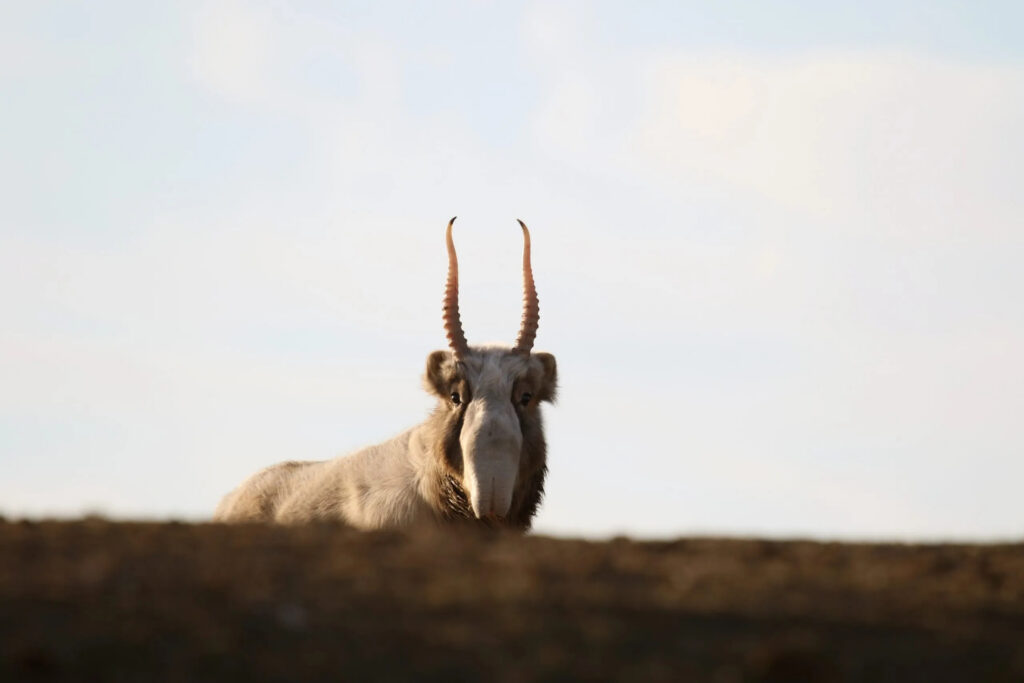
Characterized by their distinct, bulbous, trunk-like noses and ringed horns, saigas are living relics of the Pleistocene epoch. Having once shared the landscape with woolly mammoths, saber-toothed cats, and giant deer sporting twelve-foot antlers, saigas are the sole survivors of an ancient megafauna community. For millennia, their annual migrations defined the rhythm of Central Asia, serving as navigational guides for early human caravans and shaping the ecological dynamics of the treeless plains. Today, however, these prehistoric nomads face a barrage of contemporary obstacles that threaten to sever the migratory corridors they have relied on since time immemorial.
Field Audits and the Dynamics of the Rutting Season
To better understand the current distribution and health of these resilient animals, field researchers from the Association for the Conservation of Biodiversity of Kazakhstan (ACBK) conduct routine seasonal audits across the western reaches of the country’s vast steppes. Joining these conservation biologists during the critical rutting season provides firsthand insight into the complex behaviors that govern saiga survival.
The rutting season represents a period of intense biological activity. Antelopes converge from across the region, forming massive single-file lines before gathering for competitive displays and mating rituals. Male saigas engage in vigorous headbutting contests to establish dominance and impress prospective mates, utilizing their signature enlarged snouts. These specialized nasal passages are vital evolutionary adaptations, serving to filter out choking dust during dry summers and warm frigid winter air before it reaches their lungs. The sheer physical toll of the rut is immense; many males expend so much energy on display and combat that they succumb to exhaustion, while females carefully select mates based on physical vigor and snout size.
The timing of these seasonal gatherings coincides with unpredictable meteorological shifts. Seasonal rains frequently transform the sparse grasslands into deep, impassable sludge, testing the endurance of both field vehicles and researchers. As Arctic fronts sweep across the border, bringing sudden drops in barometric pressure and blinding whiteout conditions, the resilience of both the wildlife and the conservation teams is pushed to its absolute limits.
The Historical Tapestry of the Eurasian Steppe
The human history of this region is inextricably linked to the patterns of migration established by both wildlife and nomadic peoples. Dating back to the Early Iron Age, the concept of nomadism formed the bedrock of regional civilization. Linguistic analyses suggest that the ethnonym "Kazakh" derives from the Turkic word qaz, meaning wanderer or vagabond. For generations, small human communities practiced vertical nomadism, moving livestock to higher altitudes during scorching summers and retreating to sheltered river valleys ahead of punishing winter gales.
These historical transit corridors gradually coalesced into the expansive network of trade routes known collectively as the Great Silk Road. The fertile banks of the Ural River, which serves as the natural geographical boundary between Europe and Asia, functioned as a vital transcontinental crossroads. Strategic settlements along the river provided merchants with essential stopovers to rest, trade knowledge, and replenish supplies.
Throughout this history, saigas maintained a mythical status among overland travelers. Ancient cave paintings dating back to the seventh century BCE depict the antelope as elusive and enduring symbols of the harsh terrain. However, this ancient symbiosis between human nomadism and wildlife migration was profoundly disrupted during the twentieth century. Under the Soviet Union, mandatory sedentarization policies forced mobile populations into permanent agricultural settlements. While framed as modernization, these policies fundamentally altered human relationships with the land. Because much of the steppe soil proved entirely unsuitable for crop cultivation, these agricultural experiments largely failed, leaving behind a fragmented landscape crisscrossed by new roads, fences, and railways.
Infrastructure Fragmentation and the Loss of Spatial Knowledge
While human populations largely transitioned to sedentary, urban lifestyles, saigas maintained their ancient migratory imperatives. Unfortunately, the proliferation of linear infrastructure—such as border fences, highways, and electrified rail lines—has created severe barriers across their traditional ranges.
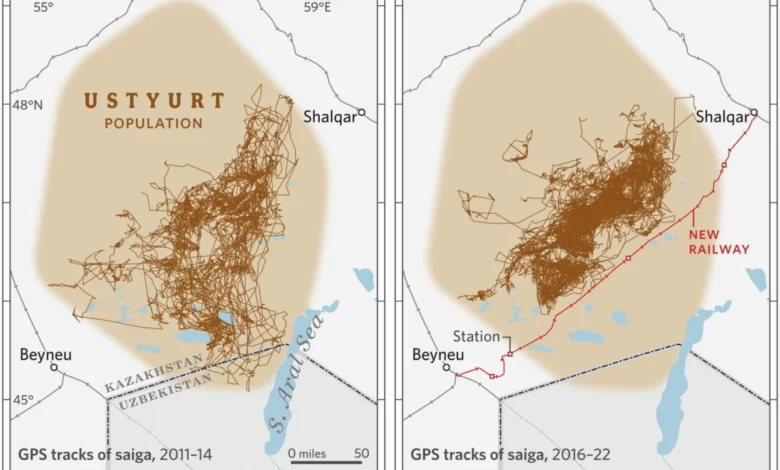
Data collected via GPS telemetry paints a clear picture of this fragmentation. Tracking studies conducted by ACBK and partner organizations reveal how major construction projects have abruptly halted historic migration routes. For instance, rail lines constructed in 2014 effectively severed populations that previously trekked between Kazakhstan and Uzbekistan. Telemetry data from the pre-construction era shows dense clusters of movement across borders, whereas post-construction data reveals animals turning back despondently at the tracks, unable to access traditional watering holes and foraging grounds to the south.
This physical obstruction triggers a secondary crisis: the loss of generational spatial knowledge. Young saigas learn migration routes, hazard avoidance, and foraging locations through active observation of older herd members. When migration paths are blocked, this cultural transmission breaks down, mirroring the cultural erosion experienced by human nomadic societies forced into permanent settlements. Conservation scientists emphasize that the erasure of these migratory pathways is as detrimental to wildlife as the loss of a language is to human culture.
Collaborative Conservation and Cross-Border Mitigation
Recognizing the existential threat posed by landscape fragmentation, conservationists have mobilized significant cross-border mitigation strategies. In partnership with the Kazakh government, ACBK has helped establish new wildlife sanctuaries informed directly by empirical GPS tracking data. Furthermore, conservationists have engineered specialized saiga-friendly crossing infrastructure along rail corridors. These structures feature gently sloping dirt ramps that match the height of railway tracks, creating the illusion of a natural break in the barrier, paired with distant cattle-guard fencing to prevent lethal train collisions.
International cooperation has yielded similar successes further south. In collaboration with Uzbek authorities, conservationists have successfully redesigned border security fencing. Traditional barbed-wire barriers have been replaced with X-shaped configurations that block vehicular traffic while leaving adequate clearance for saigas to slip through safely. These targeted interventions aim to restore ecological connectivity across the plateau, allowing herds to re-establish historic migration circuits.
Broader Implications for Ecological Resilience
The ongoing efforts to safeguard the saiga antelope highlight broader lessons regarding landscape connectivity and climate resilience in Central Asia. As climate change increases the frequency of extreme weather events across the Eurasian steppe, the ability of wildlife to move freely in search of resources becomes increasingly critical.
Maintaining open landscapes benefits not only the surviving herds of saigas but also preserves the ecological integrity of one of the planet’s last remaining large-scale temperate grassland ecosystems. By bridging the gap between historical land-use patterns and modern infrastructure planning, conservation organizations demonstrate that sustainable coexistence between industrial development and ancient wildlife migrations is achievable. As thousands of saigas continue to course across the frozen snowfields each winter, their enduring presence remains a powerful testament to the resilience of the natural world against the relentless march of human modernization.