The Essential Guide to Selecting and Maintaining High-Performance Baking Sheets for the Modern Kitchen

The humble baking sheet is perhaps the most versatile instrument in the culinary arsenal, serving as the backbone for everything from high-volume holiday cookie production to streamlined weeknight sheet-pan dinners. Despite its simplicity, the quality and material composition of this bakeware can profoundly influence the outcome of roasted vegetables, delicate pastries, and proteins. Following rigorous, multi-stage testing of 16 different models, industry experts and professional chefs have reached a consensus: for the vast majority of home and commercial applications, uncoated aluminum remains the gold standard for thermal conductivity, durability, and value.

Chronology of Culinary Bakeware Development
Historically, the professional kitchen has relied on heavy-gauge aluminum for its unparalleled ability to manage heat transfer. In the early 20th century, the transition from heavy cast iron and enamelware to lighter, more conductive materials allowed for faster service and more consistent results. By the mid-1900s, the "half-sheet" pan—measuring approximately 18 by 13 inches—became the standardized unit of measure in commercial kitchens across North America. This standardization was not arbitrary; it was designed to fit perfectly into industrial rack ovens, ensuring even airflow and optimal heat distribution.
In recent decades, the rise of "nonstick" consumer culture led manufacturers to coat these essential tools with PTFE and ceramic layers. However, modern testing indicates that these coatings often impede the browning process, accelerate the degradation of the pan’s surface, and provide a false sense of longevity. As sustainability becomes a greater concern for home cooks, the shift back to bare, recyclable aluminum has gained significant momentum.

Performance Data and Material Analysis
The primary metric for evaluating a baking sheet is its thermal conductivity—the speed at which the metal absorbs and distributes heat. Testing protocols conducted in 450°F convection environments reveal a stark disparity between materials:
- Aluminum: Demonstrates the highest thermal conductivity. It reaches target temperatures rapidly and dissipates heat effectively upon removal from the oven, preventing carry-over cooking that can ruin delicate baked goods.
- Aluminized Steel: While durable, this material exhibits a slower response time to temperature fluctuations. Data shows that these pans can lag by an average of 25°F compared to pure aluminum, which may require users to adjust cook times for recipes developed on standard aluminum sheets.
- Tri-Ply Stainless Steel: Though often marketed as a premium alternative, stainless steel’s low thermal conductivity often leads to uneven browning and undercooked centers in standardized recipe testing. The high cost—often exceeding $100 per unit—is rarely justified by performance metrics.
The Superiority of Uncoated Aluminum
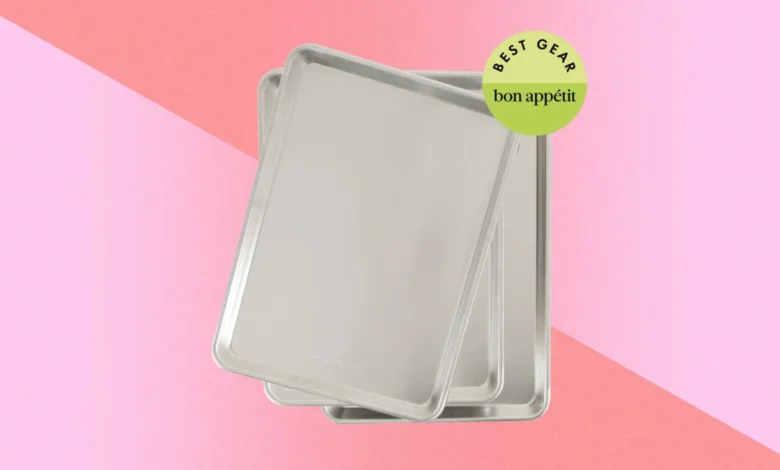
The Nordic Ware Natural Aluminum Half-Sheet consistently outperformed competitors in controlled stress tests. Constructed from 20-gauge aluminum, these pans resist the common phenomenon of "oil canning" or warping, provided they feature a reinforced, rolled rim. While all metal expands and contracts under extreme heat, the structural integrity of a high-quality rim ensures that any warping remains minimal and manageable, rather than folding inward and potentially spilling juices or batter.

From a maintenance perspective, uncoated aluminum is superior for its longevity. Unlike nonstick surfaces that chip and flake—necessitating disposal—uncoated aluminum can be scoured and restored. While the surface will naturally develop a patina (staining) over time due to the oxidation of the metal and the caramelization of food particles, this is a cosmetic trait rather than a functional defect.
Strategic Selection by Task
Understanding the taxonomy of sheet pans is vital for effective kitchen management. The industry-standard half-sheet remains the most practical choice for daily use, fitting most residential ovens comfortably. However, the "quarter-sheet" (roughly 13 x 9 inches) has become increasingly indispensable for smaller tasks. These smaller units are ideal for:

- Toasting ingredients: Efficiently browning nuts, seeds, or breadcrumbs without the wasted space of a larger pan.
- Mise en place: Serving as an organized station for prep work or as a tray for transporting ingredients to an outdoor grill.
- Toaster Oven Compatibility: Providing a high-quality surface for small-batch roasting that standard, often flimsy toaster oven trays cannot match.
Expert Guidelines for Maintenance and Longevity
Professional kitchens follow a strict regimen to preserve the lifespan of aluminum bakeware. The most critical factor is the avoidance of automated dishwashers. The harsh, caustic detergents used in dishwashers, combined with high-pressure water jets and extreme heat cycles, will cause the aluminum to oxidize prematurely, turning the surface dull, pitted, and rough to the touch.
For optimal performance, users should employ the following protocols:

- Hand Washing: Use mild soap, warm water, and a non-abrasive sponge.
- Avoid Metal Utensils: While aluminum is durable, using serrated knives directly on the surface will create deep gouges that trap food and bacteria.
- Strategic Use of Liners: Parchment paper or silicone mats should be used when baking cookies or sticky foods. This not only preserves the pan’s surface but also eliminates the need for excess fats, allowing for cleaner browning.
Broader Economic and Environmental Implications
The consumer trend toward "disposable" cookware has had measurable environmental consequences. Nonstick pans, which have a limited lifespan of 1–3 years under heavy use, contribute significantly to landfill waste, as the mixed materials (metal cores with chemical coatings) are difficult to separate for recycling.
Conversely, the shift toward high-quality, uncoated aluminum aligns with circular economy principles. Aluminum is one of the most energy-efficient materials to recycle, and a well-maintained pan can last a household five to ten years before it reaches the end of its life. From an economic standpoint, the cost-to-use ratio of a $15–$20 aluminum sheet that lasts a decade is substantially lower than that of a $50–$100 nonstick pan that requires replacement every few years.

Conclusion: The Case for Simplicity
The data is clear: the most expensive option is rarely the most effective in the context of basic baking. By prioritizing thermal conductivity and material purity, home cooks can achieve results that mirror those of professional pastry chefs. Whether roasting a chicken or preparing a holiday dessert, the consistent, predictable performance of a high-quality aluminum sheet pan remains an essential element of successful culinary practice. By rejecting the lure of expensive, specialized coatings and focusing on the fundamentals of heat transfer, the home kitchen can achieve a higher standard of efficiency and sustainability. When the pan eventually warps beyond use after years of service, the ability to recycle it serves as a final, environmentally responsible benefit that few other kitchen tools can offer.