Nestled gracefully along the shores of the Argolic Gulf in the northeastern Peloponnese, Nafplio stands as one of the most historically resonant and visually striking coastal destinations in Greece. Often spelled Nafplion due to linguistic evolutions over centuries, this picturesque city seamlessly bridges antiquity, Venetian maritime dominance, Ottoman rule, and modern Greek history. Located less than a two-hour drive southwest of Athens, Nafplio serves as an ideal cultural and geographical gateway for travelers seeking to explore the broader Argolis region, offering a sophisticated blend of architectural heritage, coastal beauty, and culinary excellence.

Strategic Military History and the Evolution of a Capital

The historical narrative of Nafplio is deeply intertwined with its formidable geography. Dominating the cityscape from a 215-meter-high precipice is the Palamidi Fortress, an architectural marvel constructed by the Venetians during their second period of rule in the early 18th century. Alongside the older Akronafplia Castle—whose foundations date back to the Bronze Age—and the iconic Bourtzi sea fortress situated in the middle of the harbor, Nafplio was designed as an impenetrable stronghold.

Over the centuries, control of the city shifted between Byzantine, Venetian, Frankish, and Ottoman forces, each leaving an indelible mark on its urban planning and defensive architecture. During the Greek War of Independence, which began in the 1820s, Nafplio played a pivotal role as a primary military and political objective. Following its liberation from Ottoman forces, the city earned the prestigious distinction of becoming the first official capital of the modern Greek state in 1829, serving as the seat of government until the capital was moved to Athens in 1834. This foundational status is commemorated in landmarks such as the Vouleftiko—a former Ottoman mosque that housed the first Hellenic Parliament—and Syntagma Square, the historic heart of the Old Town.

Top Cultural and Architectural Landmarks

Visiting Nafplio offers a multi-layered experience defined by Venetian neoclassical mansions, labyrinthine cobblestone alleys draped in vibrant bougainvillea, and carefully preserved public squares. Urban planners and local historians frequently cite the city as a prime example of preserved 19th-century Greek urban architecture.

Key points of interest for visitors include:

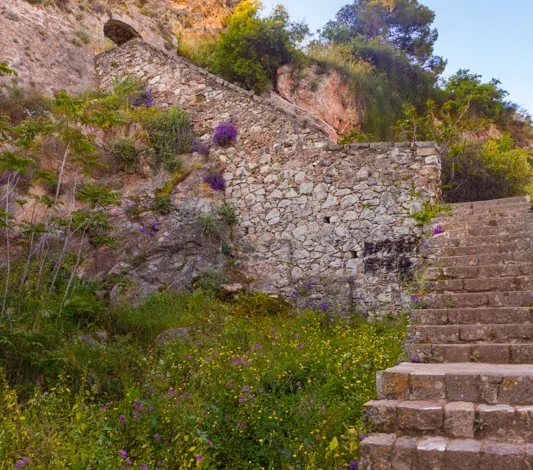
- The Palamidi Fortress: Accessible either by vehicle or via a famous stone staircase consisting of nearly 1,000 steps, the fortress complex features eight distinct bastions and provides panoramic views of the Argolic Gulf and the Old Town.
- The Old Town: Characterized by narrow pedestrian thoroughfares, artisanal boutiques, art galleries, and traditional cafes, the Old Town area represents the residential and commercial soul of the municipality.
- Bourtzi Castle: Located on the islet of St. Theodore just off the coast, this 15th-century Venetian fortification was originally built to protect the harbor from maritime invasions before serving variously as a residence for executioners, a prison, and a luxury hotel.
- The Komboloi Museum: Dedicated to the preservation and history of traditional Greek worry beads (komboloi), this institution showcases artifacts crafted from amber, silver, and semi-precious stones, highlighting their cultural significance in promoting mental focus and relaxation.
- The Archaeological Museum of Nafplio: Situated on the western side of Syntagma Square within a preserved Venetian arsenal building, the museum houses artifacts spanning from the Neolithic period through the Roman era, recovered from major regional excavations.
Regional Day Trips and Archaeological Excursions

Beyond the immediate municipal boundaries, Nafplio functions as an optimal base for exploring several UNESCO World Heritage Sites and prominent agricultural and viticultural zones within the Peloponnese peninsula.

Mycenae and Epidaurus

Located a short drive north of Nafplio lie the ruins of Mycenae, the legendary Bronze Age citadel that served as the center of Mycenaean civilization and the seat of King Agamemnon as recorded in Homeric epic poetry. Key structures include the Lion Gate, the Cyclopean walls, and the monumental beehive-shaped Treasury of Atreus.

Further east lies the Sanctuary of Asklepios at Epidaurus, home to the Ancient Theater of Epidaurus. Constructed in the 4th century BC by Polyclitus the Younger, the theater is globally renowned for its exceptional acoustics and structural symmetry, capable of seating up to 14,000 spectators. The site remains an active cultural venue, hosting classical drama productions during the annual Athens-Epidaurus Festival.

Viticulture in Nemea

The nearby region of Nemea represents one of Greece’s most celebrated wine-producing areas, anchored by the indigenous Agiorgitiko grape variety. Winemakers in the region combine ancient agricultural traditions with modern oenological techniques to produce structured red wines, complemented by historical sites such as the ancient Stadium of Nemea and the Temple of Zeus.

Coastal Infrastructure and Accessibility

Transport infrastructure surrounding Nafplio supports both independent tourism and regional commerce. The city is accessible from Athens via a 145-kilometer highway network or through scheduled intercity bus (KTEL) services that operate regular daily routes. While vehicular access is viable, local municipal authorities and tourism boards strongly advise parking outside the pedestrianized Old Town—particularly near Arvanitia Beach—to preserve the historic streetscape and alleviate congestion during peak travel seasons.

The local economy benefits from a balanced mix of maritime trade, agricultural production (notably citrus fruits and olives), and cultural tourism. Regional hospitality providers range from restored Venetian townhouses operating as boutique pensions to luxury resorts situated along the rocky promontories of Akronafplia. Through sustained preservation efforts and careful urban management, Nafplio maintains its status as a vital historical repository and a premier destination within the southeastern Mediterranean tourism sector.