Navigating the Adriatic Corridor: A Comprehensive Travel and Logistical Analysis of the Zagreb-to-Dubrovnik Route


The overland and maritime corridor connecting Croatia’s continental capital of Zagreb to its southern coastal jewel, Dubrovnik, represents one of Southeast Europe’s most economically vital and geographically diverse travel routes. Spanning hundreds of kilometers across contrasting landscapes—from the Pannonian plain and the rugged karst of Gorski Kotar to the indented, island-studded Dalmatian coastline—this passage encapsulates the evolution of Croatian tourism infrastructure over the past two decades. As regional authorities and travel operators seek to balance surging visitor numbers with sustainable regional development, understanding the structural dynamics of this route is increasingly essential for travelers and tourism economists alike.
Geographical Scope and Infrastructure Evolution

The route from Zagreb to Dubrovnik traverses several distinct climatic and topographical zones. Historically, transit between the capital and the far south required navigating winding two-lane coastal roads, most notably the historic Jadranska Magistrala (Adriatic Highway), which was constructed primarily in the 1950s and 1960s. While the opening of the A1 motorway significantly accelerated mainland transit times, modern travel planning increasingly incorporates multi-modal transport strategies, integrating highways, regional ferries, catamaran networks, and air links.
Recent infrastructure milestones, most notably the completion of the Pelješac Bridge in 2022, have fundamentally altered transit logistics by reconnecting the southernmost exclave of Dubrovnik-Neretva County to the rest of the Croatian mainland without requiring border crossings through Bosnia and Herzegovina at Neum. This engineering feat reduced transit times, streamlined freight and passenger movement, and prompted a reassessment of how regional itineraries are structured.
Chronological Itinerary and Regional Highlights

A comprehensive evaluation of the Zagreb-Dubrovnik corridor reveals a sequence of distinct micro-destinations, each offering unique cultural assets, historical contexts, and logistical considerations.
Zagreb: The Continental Gateway
Positioned in the northwest, Zagreb serves as the administrative and cultural heart of Croatia. Unlike the seasonal intensity of the Adriatic coast, Zagreb operates on a year-round economic and cultural calendar. Urban planners and tourism boards frequently promote the capital as an essential acclimatization zone for international visitors. Historical records trace the city’s urban core to the medieval settlements of Kaptol and Gradec, which merged in the 19th century. Today, the Upper Town (Gornji Grad) anchors the city’s heritage tourism, while modern culinary and hospitality sectors provide a bridge between Central European and Mediterranean traditions.

Opatija and the Kvarner Gulf
Moving southwest toward the coast, Opatija emerges as the birthplace of Croatian seaside tourism. During the Austro-Hungarian Empire in the late 19th and early 20th centuries, Opatija was established as a premier health resort for European aristocracy. The legacy of this era remains visible in the grand Belle Époque architecture, manicured parklands, and the 12-kilometer Lungomare coastal promenade. Economic analyses of the Kvarner region highlight Opatija as a model for high-end, wellness-oriented tourism that successfully mitigates seasonal fluctuations.
The Island of Rab and Kvarner Archipelago

Offshore, the island of Rab presents a case study in specialized island tourism. Renowned for its compact medieval old town defined by four distinct Romanesque bell towers, Rab is also notable within the Kvarner archipelago for possessing rare natural sandy beaches. Tourism data indicates that island destinations like Rab require careful ecological management to preserve fragile coastal ecosystems while accommodating summer visitor influxes.
Zadar: Innovation in Coastal Urbanism
Further south in northern Dalmatia, Zadar combines ancient Roman heritage with contemporary public art. The city’s peninsula layout preserves remnants of a Roman forum alongside Venetian fortifications designated as UNESCO World Heritage sites. In the 21st century, Zadar successfully integrated modern architectural installations—such as the Sea Organ (Morske orgulje), which generates ambient music via wave action, and the Greeting to the Sun monument—into its historic waterfront. Urban development studies frequently cite Zadar as a successful example of revitalizing public spaces to enhance visitor engagement without compromising archaeological integrity.

Krka National Park and Šibenik
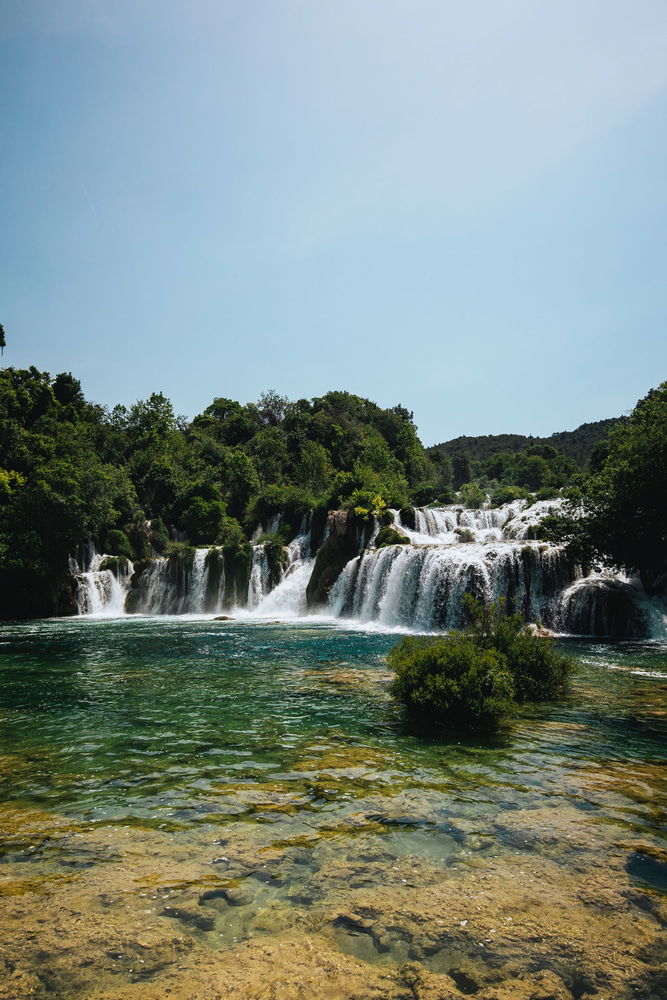
The hinterland and immediate coast of central Dalmatia feature Krka National Park, established to protect the middle and lower course of the Krka River. Known for its travertine cascading waterfalls and rich biodiversity, the park represents a cornerstone of Croatia’s inland natural heritage management. Visitor capacity caps have been implemented in recent years by park authorities to protect delicate hydrological and botanical habitats.
Adjacent to the park is Šibenik, home to the Cathedral of St. James, a masterpiece of Renaissance architecture constructed entirely from stone without mortar by masters such as Juraj Dalmatinac and Nikola Firentinac. Šibenik’s focus on cultural heritage tourism has positioned it as a cultural counterweight to larger neighboring urban centers like Split.

Korčula and the Central Dalmatian Islands
In the southern maritime zone, the island of Korčula offers a preserved medieval urban grid modeled in a distinctive fish-bone pattern designed to optimize airflow while mitigating winter winds. Historically linked to the Venetian Republic and traditionally claimed as the birthplace of Marco Polo, Korčula’s economy relies heavily on viticulture—particularly indigenous white wine varietals such as Pošip and Grk—alongside maritime tourism.
Dubrovnik: The Adriatic Benchmark
The terminus of the route, Dubrovnik, remains Croatia’s most globally recognized tourism brand. Encircled by an intact circuit of medieval stone ramparts, the Old Town (Stari Grad) functions as an open-air museum of Gothic, Renaissance, and Baroque architecture. However, Dubrovnik has also served as a primary testing ground for overtourism mitigation strategies. Municipal authorities and international heritage organizations, including UNESCO, have closely monitored visitor numbers, implementing daily caps on cruise ship passengers and pedestrian flow management systems within the historic walls to safeguard structural integrity and local quality of life.
Logistical Analysis and Transport Implications
Navigating the transit corridor between Zagreb and Dubrovnik involves significant logistical planning, particularly during the peak summer months (July and August). Data from the Croatian Bureau of Statistics indicates that vehicular traffic on coastal corridors increases exponentially during this period, resulting in congestion at key transit nodes, ferry terminals, and border checkpoints.

Industry analysts note a growing shift toward alternative transit models, such as boutique small-ship coastal cruising and integrated catamaran services. These transport modes allow travelers to bypass highway congestion and road logistics by utilizing maritime routes that connect mainland hubs directly with island ports. By anchoring in proximity to historic centers, small-ship itineraries reduce daily vehicular carbon footprints and distribute tourism expenditure more evenly across island economies.
Economic and Policy Implications
The continuous development of the Zagreb-Dubrovnik corridor underscores broader national economic strategies. Tourism accounts for a substantial percentage of Croatia’s Gross Domestic Product (GDP), making infrastructural resilience and regional dispersion top priorities for the Ministry of Tourism and Sport. Policy initiatives increasingly emphasize sustainable tourism frameworks, encouraging travelers to explore lesser-known continental and northern Adriatic locations—such as Zagreb, Opatija, and Rab—to alleviate seasonal pressure on southern hotspots like Dubrovnik.

As regional transportation networks continue to modernize, the corridor between the capital and the southern coast will remain a vital barometer for the health, adaptability, and sustainability of Croatia’s broader tourism and economic landscape.