Young French Climbers Forge Daring New Route on Grandes Jorasses North Face, Marking a Significant Feat in Alpine History

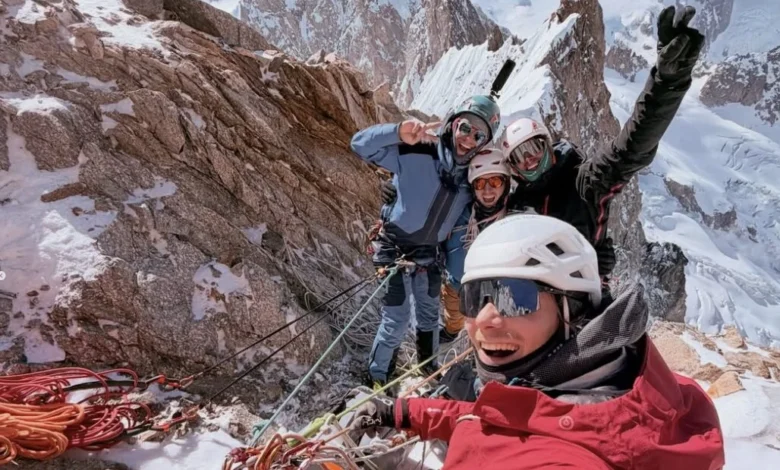
In a testament to the enduring spirit of exploration and innovation in alpinism, a quartet of young French climbers has successfully established a groundbreaking new route on the iconic North Face of the Grandes Jorasses in the Mont Blanc Massif. Arthur Pointdefert, Pierre Girot, Hugo Peruzzo, and Kilian Moni, members of France’s prestigious National Mountaineering Excellence Group (GEAN), completed the challenging 1,100-meter ascent, which they christened "Jorassique Pâques" (Jorassic Easter), between April 3 and 6, 2026. This remarkable achievement underscores the continued potential for pioneering ascents even on faces long considered thoroughly explored, demonstrating ingenuity in identifying and conquering previously deemed "unclimbable" sections of the legendary peak.
The Grandes Jorasses, an imposing peak rising to 4,208 meters (13,806 feet) on the border between France and Italy, holds a hallowed place in the annals of mountaineering. Its North Face, a colossal bastion of rock and ice, is universally recognized as one of the "Three Great North Faces of the Alps," alongside the Eiger and the Matterhorn. For decades, this formidable wall has captivated and challenged the world’s most elite alpinists, witnessing numerous historic ascents that pushed the boundaries of climbing technique and human endurance. Routes like the Cassin Ridge on the Pointe Marguerite and the Walker Spur on the Pointe Whymper (first climbed in 1938 by Riccardo Cassin and his team) are legendary, each representing a pivotal moment in the evolution of alpine climbing. The sheer scale, technical difficulty, and often treacherous weather conditions associated with the Grandes Jorasses North Face ensure that any new line established upon it is a significant event, meticulously scrutinizing the face’s complex topography for overlooked opportunities.
The challenge for modern alpinists on such a historic face lies not just in climbing its immense verticality, but in discovering genuinely new territory. With decades of intensive exploration, many climbers believed that virtually every conceivable line had already been ascended. However, the GEAN team approached this saturated landscape with a fresh perspective, focusing on areas traditionally dismissed as too steep, too exposed, or simply impossible. "In the Grandes Jorasses, finding a line without crossing another route isn’t so easy; that’s also what makes this mountain so fascinating," the GEAN members collectively stated, reflecting on the intricate puzzle presented by the face. Their innovative strategy involved targeting one of the face’s steepest bastions, an overhanging section that, from a ground-level perspective, appeared utterly impenetrable. This bold vision allowed them to unlock a new dimension of potential on a seemingly exhausted canvas.
The National Mountaineering Excellence Group (GEAN), under the auspices of the French Federation of Alpine and Mountain Clubs (FFCAM), plays a crucial role in nurturing the next generation of French alpinists. Comprising young, highly skilled climbers, GEAN provides advanced training, mentorship, and logistical support for ambitious projects. Arthur Pointdefert, Pierre Girot, Hugo Peruzzo, and Kilian Moni exemplify the group’s mission, showcasing not only exceptional physical prowess but also the intellectual curiosity and strategic thinking required to innovate in a mature sport. Their collective decision to tackle an "unclimbable" section of the Grandes Jorasses North Face was a direct outcome of GEAN’s emphasis on pushing boundaries and rethinking conventional wisdom in high-altitude climbing.
The expedition to establish "Jorassique Pâques" was not a spontaneous endeavor but the culmination of meticulous planning and a prior reconnaissance attempt. The team first ventured to the Grandes Jorasses in December, undertaking an initial push to scout the lower sections of their intended line. This preliminary effort, while not leading to a complete ascent, proved invaluable. It allowed them to familiarize themselves with the approach, assess the snow and ice conditions, identify potential bivy sites, and gain critical insights into the initial technical challenges of the route. This initial experience, though cut short by prevailing conditions, was a crucial learning phase, informing their subsequent, successful April attempt.
The decisive push began on April 3, 2026. After spending a night at the base of the formidable North Face, the team embarked on the demanding task of hauling their extensive gear, including portaledges, ropes, and provisions, up the initial pitches. Their objective was to reach their previously established high point from the December attempt, a strategic decision that saved valuable time and energy. Upon reaching this pre-determined location, they meticulously set up their first bivy on portaledges, specialized hanging tents designed for multi-day ascents on vertical walls. These platforms, while offering a semblance of rest, are inherently exposed to the elements, providing a stark reminder of the commitment required for such a climb.
The morning of April 4 dawned with an unwelcome surprise. "The next day, after an unpleasant night, we woke up with soaked sleeping bags and a portaledge already riddled with holes," the team recounted, vividly describing the harsh realities of their environment. Despite the significant discomfort and the compromised state of their equipment, their resolve remained unbroken. The four climbers, demonstrating remarkable mental fortitude, made the collective decision to press on. From this precarious bivy, they ventured into completely unknown territory, the terrain becoming progressively steeper and more challenging with each pitch. The climbing involved a complex blend of mixed techniques, navigating sections of rock, ice, and frozen snow. As they later confided to Montagnes.com, the climb proved "harder and scarier than they had envisioned," a testament to the face’s inherent unpredictability and the raw technical demands of their chosen line. To compound the difficulties, a severe snowstorm began to gather force, engulfing the upper reaches of the Grandes Jorasses and adding a terrifying dimension to their ascent.
The second night on the wall, from April 4 to 5, became an intense battle for survival against the raging elements. The snowstorm intensified, unleashing relentless spindrift that cascaded down the face, burying their portaledges and threatening to dislodge their gear. High winds buffeted their exposed platforms, making sleep virtually impossible and testing their physical and psychological limits. The constant threat of frostbite, hypothermia, and equipment failure loomed large in the frigid, tempestuous environment. This ordeal, characteristic of high-altitude alpine storms, demanded every ounce of their resilience and commitment.
Against all odds, the GEAN team emerged from the storm-ravaged night on April 5, battered but undeterred. Despite the fresh accumulation of snow, which often complicates climbing by obscuring features and creating unstable conditions, they maintained a strong, determined pace. Their skill and experience allowed them to navigate the newly snow-covered rock and ice, methodically making progress towards the summit. The technical difficulties encountered were substantial, rated up to M7 for mixed climbing (involving both ice axe and rock climbing techniques) and A3 for aid climbing (requiring the placement of artificial gear for upward progress, often on otherwise unscalable rock). These ratings signify extremely challenging and sustained climbing, demanding a high level of proficiency in various disciplines.
Their perseverance was ultimately rewarded. After three days of relentless effort and an arduous ascent, the four climbers successfully reached the summit of Point Whymper, one of the Grandes Jorasses’ six main peaks, standing at an elevation of 4,184 meters. The triumphant moment, achieved amidst the remnants of the storm, marked the successful completion of "Jorassique Pâques." The name, a playful nod to both the Jurassic period’s ancient and formidable creatures and the timing of their Easter-week ascent, perfectly encapsulates the epic nature of their journey and the primordial forces they confronted.
The establishment of "Jorassique Pâques" represents more than just a new line on a mountain; it signifies a significant contribution to the ongoing narrative of alpine climbing. The GEAN team’s strategy of seeking out "unclimbable" sections challenges conventional wisdom and highlights the continuous evolution of climbing techniques and mental approaches. Their success demonstrates that even on the most historically significant and thoroughly explored faces, there remains scope for innovation. This achievement will undoubtedly inspire future generations of alpinists to re-examine established paradigms and to search for new possibilities in seemingly exhausted territories.
The broader implications of this ascent resonate within the global climbing community. It reaffirms the vitality of French alpinism and the effectiveness of programs like GEAN in fostering world-class talent. For the GEAN members themselves, this expedition is a formative experience, pushing their limits and forging an unbreakable bond through shared adversity. Their detailed accounts, shared through platforms like Montagnes.com and social media, provide invaluable insights into the realities of modern big-wall alpine climbing, serving as both inspiration and educational material for aspiring mountaineers.
In an era where many adventure sports are becoming increasingly commercialized or focused on speed records, the ascent of "Jorassique Pâques" stands as a powerful reminder of the fundamental allure of alpinism: the pursuit of the unknown, the mastery of challenging terrain, and the profound connection with nature’s raw power. Arthur Pointdefert, Pierre Girot, Hugo Peruzzo, and Kilian Moni have not only added a new chapter to the legendary history of the Grandes Jorasses but have also illuminated the path for future explorations on the planet’s most formidable peaks. Their ingenuity, resilience, and unwavering commitment have carved out a truly unique legacy on one of the Alps’ most revered walls.