Navigating the Steppe: Conservationists Fight to Protect the Ancient Migration Routes of Kazakhstan’s Saiga Antelope

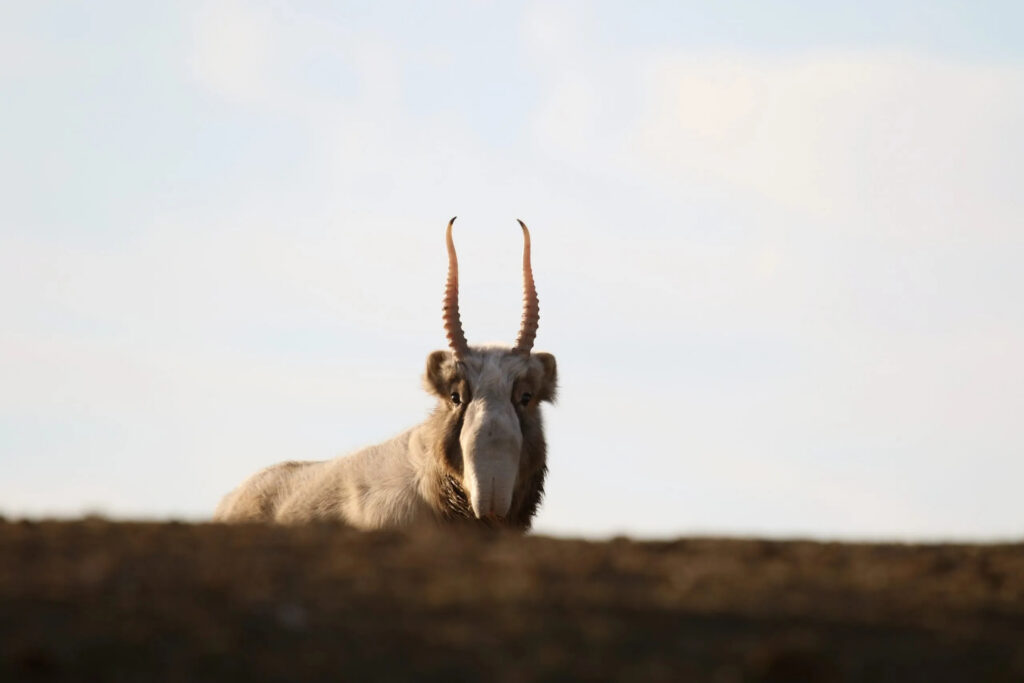
The rugged expanses of the Eurasian steppe serve as the backdrop for one of the most remarkable wildlife conservation efforts of the twenty-first century. As vehicles navigate the unpaved mud paths maintained only by tire tracks, researchers from the Association for the Conservation of Biodiversity of Kazakhstan (ACBK) meticulously monitor the seasonal movements of the saiga antelope (Saiga tatarica). These resilient ungulates, easily recognizable by their distinctive, elongated, trunk-like snoses, represent a direct living link to the Pleistocene epoch. Having outlived woolly mammoths and saber-toothed cats, saigas now face a modern gauntlet of anthropogenic barriers, including expanding railways, international border fences, and agricultural development that threatens to sever ancient migration corridors critical to their survival.
Main Facts and Current Status of the Saiga Population
The saiga antelope is a nomadic herbivore uniquely adapted to the harsh conditions of the Central Asian semidesert. During the annual rutting season, herds congregate in massive numbers across the treeless plains. Mature males engage in intense physical competition, utilizing their ringed horns and displaying their prominent snouts—vital anatomical adaptations designed to warm freezing winter air and filter dust during dry summer months.
In recent decades, however, these sweeping migrations have been severely disrupted. Infrastructure projects such as linear railways and security fencing have fragmented the saigas’ historic range, which once extended from the Caucasus Mountains to Mongolia. Data compiled by wildlife biologists demonstrate that linear infrastructure can halt migration entirely, trapping populations on suboptimal sides of tracks and fences where essential seasonal resources, such as fresh water and grazing lands, become inaccessible. This spatial disruption often leads to a phenomenon scientists liken to cultural amnesia, wherein younger generations of animals lose the ancestral knowledge of safe migratory pathways and water sources.
Chronology and Historical Context
The history of movement across the western Kazakh steppe is deeply intertwined with both wildlife migrations and human nomadism. Since the Early Iron Age, human populations in the region practiced seasonal pastoralism, following natural transit corridors that eventually laid the foundational network for portions of the historic Great Silk Road. Situated along the fertile banks of the Ural River—the natural boundary dividing Europe and Asia—this transcontinental crossroads functioned as a vital hub for weary caravans.
Traditional nomadic practices persisted through successive eras under Turkic rule, the Mongol Empire, and the Russian Empire. A profound shift occurred during the twentieth century under the Soviet Union, whose mandatory sedentarization policies effectively forced nomadic communities into fixed agricultural settlements. This top-down modernization initiative largely dismantled traditional pastoralism.
For the saiga antelope, however, nomadic life persisted, though it encountered increasingly severe obstacles. While the species survived historic hunting pressures and a catastrophic die-off in 2015 caused by hemorrhagic septicemia—which wiped out more than 200,000 individuals in a matter of weeks—rapid industrial development in the post-Soviet era emerged as an ongoing systemic threat to their long-term viability.
Supporting Data and Technological Interventions
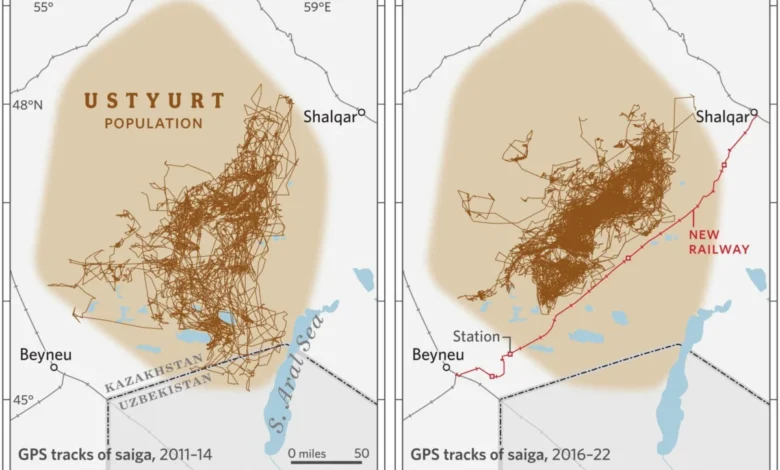
Modern conservation strategies rely heavily on advanced tracking technology to understand and mitigate these habitat fragmentations. Biologists utilize GPS satellite collars to record daily pings of saiga movements across the boundless landscape. These data streams provide high-resolution mapping capabilities that reveal precisely how herds interact with human-made barriers.
For instance, spatial tracking data from 2014 vividly illustrated the impact of a newly constructed railway line in the region. Pre-construction tracking maps showed herds routinely traversing international borders deep into Uzbekistan. Post-construction data, by contrast, depicted collared animals milling about defensively on the northern side of the tracks, unable to cross the physical barrier to reach traditional winter pastures.
To counter these systemic disruptions, ACBK, in close collaboration with the Kazakh and Uzbek governments, has initiated targeted structural modifications across the landscape. In Kazakhstan, conservationists have engineered dozens of saiga-friendly crossing points featuring sloping dirt ramps designed to match the elevation of railway tracks, effectively creating the illusion of a continuous landscape. Strategic cattle-guard fences placed at a distance prevent direct collisions between trains and wildlife. Furthermore, along the Uzbekistan border, traditional barbed-wire barriers have been reconfigured into X-shaped barricades that successfully block vehicular traffic while leaving adequate clearance for saiga movement.
Official Responses and Institutional Frameworks
Government agencies and non-governmental organizations have increasingly recognized the ecological imperative of preserving transboundary migratory corridors. The government of Kazakhstan has established new wildlife sanctuaries and protected areas, with boundaries directly informed by empirical tracking data gathered by field researchers.
International conservation bodies have also upgraded the species’ protection status in response to population recoveries following intensive anti-poaching enforcement. However, wildlife authorities emphasize that anti-poaching measures alone are insufficient if ecological connectivity is permanently severed. Intergovernmental cooperation between Kazakhstan and Uzbekistan remains critical to ensuring that border management policies accommodate the biological realities of nomadic ungulates.
Broader Impact and Implications for Conservation
The plight of the saiga antelope highlights a broader philosophical and ecological question regarding human coexistence with migratory species. Anthropogenic fragmentation of wildlife corridors not only imperils biodiversity but also erodes the ecological memory encoded within migratory herds.
As conservationists work to restore permeability to the Eurasian steppe through infrastructure retrofits and transboundary diplomacy, the saiga’s resilience offers a cautiously optimistic model for wildlife management in human-dominated landscapes. Preserving these ancient pathways ensures that the steppe remains a dynamic, interconnected ecosystem capable of sustaining one of the world’s most enduring mammalian nomads well into the future.