Beyond Amsterdam: A Comprehensive Journalistic Guide to Exploring the Cultural, Architectural, and Agricultural Landscape of the Netherlands

Millions of international travelers descend upon the Netherlands annually, frequently restricting their itineraries to the historic canals of Amsterdam and the seasonal floral displays at the Keukenhof gardens. However, a deep exploration of the country reveals a diverse tapestry of urban centers, architectural innovations, agricultural powerhouses, and centuries-old traditions located well beyond the capital. Drawing on extensive regional travel and localized observations, tourism analysts and long-term residents emphasize that the nation’s true depth lies in its secondary cities, compact historic towns, and sprawling rural landscapes.

Major Urban Landscapes Beyond the Capital
While Amsterdam serves as the primary international gateway, the administrative, commercial, and cultural weight of the Netherlands is distributed among several other major metropolitan areas, notably Rotterdam, The Hague, and Utrecht. Each city offers a distinct architectural profile and historical trajectory that contrasts sharply with the canal ring of the capital.
Rotterdam, functioning as the nation’s second-largest city, presents a starkly modern urban environment. Unlike historic centers heavily preserved from medieval times, Rotterdam underwent extensive post-World War II reconstruction, leading to an experimental skyline characterized by avant-garde architecture. Key landmarks defining the cityscape include the horseshoe-shaped Market Hall (Markthal), the innovative Cube Houses (Kubuswoningen) designed by architect Piet Blom, the historic Witte Huis—once Europe’s tallest office building—and the iconic cable-stayed Erasmus Bridge.

Maritime commerce remains central to Rotterdam’s identity. The Oude Haven (Old Harbour) preserves historical maritime vessels within a modern basin, while the Euromast observation tower, standing at 185 meters, provides panoramic vistas of the metropolitan area and the Port of Rotterdam. As the largest seaport in Europe, the Port of Rotterdam—including its industrial extension, Europoort—handles immense global cargo volumes, serving as a critical economic engine for the entire European Union.
To the west, The Hague (Den Haag) functions as the political heart of the Netherlands. Although Amsterdam is the constitutional capital, The Hague hosts the Dutch government, the Dutch royal family, and numerous international bodies, including the United Nations’ International Court of Justice. The political landscape is anchored by the Binnenhof, a sprawling Gothic castle complex serving as the meeting place for the States-General. Due to extensive modernization and renovation efforts slated to run through approximately 2031, parliamentary sessions have been temporarily relocated within the city.

Beyond governance, The Hague is a repository of high culture and miniature infrastructure. The Mauritshuis museum houses a world-renowned collection of Dutch Golden Age paintings, including works by Johannes Vermeer and Rembrandt van Rijn. For families and architectural enthusiasts, Madurodam offers a scaled-down park featuring meticulous 1:25 replicas of famous Dutch landmarks, historic cities, and infrastructure systems. Urban transit efficiently connects the governmental core to Scheveningen, a historic coastal district featuring an extensive seaside promenade, pier infrastructure, and hospitality venues.
Utrecht, ranking as the fourth-largest Dutch city, offers a medieval counterpoint to Rotterdam’s modernity and The Hague’s official gravity. Dominated by the soaring Domtoren—the tallest church tower in the Netherlands at 112 meters—Utrecht’s urban layout is defined by its historic dual-level canals, notably the Oudegracht. The city center features the Gothic Domkerk cathedral and the secluded Pandhof courtyard garden. Cultural institutions such as Museum Speelklok, which preserves a vast collection of self-playing musical instruments, and the National Railway Museum (Spoorwegmuseum) provide deep insights into European industrial and cultural heritage.

The Charm of Compact Historic Towns
Beyond the major metropolitan hubs, the Netherlands features a dense network of smaller, highly compact towns that historically served as regional epicenters of trade, art, and governance. Their scale makes them ideal destinations for short excursions.
Delft holds a prominent place in global decorative arts history as the birthplace of Delftware (Delft Blue pottery). During the 15th and 16th centuries, Delft emerged as a major economic and political center, serving as the primary residence of William of Orange. Today, visitors can tour active manufacturing facilities such as Royal Delft to observe the traditional production methods that have persisted for centuries. Art historically, Delft is inextricably linked to master painter Johannes Vermeer, whose domestic genre scenes immortalized the everyday light and architecture of the town.

Positioned in the far south of the country, Maastricht offers a cultural and geographical profile distinct from the northern provinces. Situated approximately two hours from the Randstad conurbation, Maastricht is historically recognized across Europe as the birthplace of the European Union and the single European currency, formalized via the Maastricht Treaty of 1992. Domestically, it is celebrated as one of the oldest cities in the Netherlands, featuring the nation’s oldest bridge (St. Servaas Bridge) and oldest surviving city gate (Helpoort). Architectural adaptations are visible in sites such as Dominicanenkerk, a 13th-century Gothic church successfully repurposed into an internationally acclaimed multi-level bookstore.
Haarlem, located a mere 15 minutes by rail from Amsterdam, combines urban sophistication with historic intimacy. The Grote Markt, the central square, is flanked by the late-Gothic Cathedral of St. Bavo. Haarlem is particularly famous for its historic hofjes—hidden almshouses surrounded by tranquil enclosed courtyard gardens established centuries ago for charitable housing. The cityscape is further anchored by Windmill De Adriaan, an 18th-century reconstruction positioned on the banks of the Spaarne River that functions as a museum detailing regional milling technology.

Leiden, situated midway between Amsterdam and The Hague, is renowned for its academic heritage as the home of the nation’s oldest university, founded in 1575. The city’s extensive canal network and historical ramparts frame numerous museums dedicated to science, ethnology, and natural history. The Beestenmarkt square serves as a central social hub, offering culinary establishments and departure points for canal navigation.
Agricultural Traditions: Cheese Markets and Windmills
Two agricultural and industrial pillars define the global perception of Dutch heritage: cheese production and wind energy utilization.

The Netherlands is historically synonymous with major cheese varieties, most notably Gouda and Edam, both bearing names originating from Dutch municipalities. Traditional trading practices are preserved through seasonal open-air cheese markets, held primarily between April and September in Alkmaar and Gouda. These events recreate historic commercial rituals, featuring participants in traditional attire, horse-drawn flatbeds laden with spherical cheeses, and the historic handjeklap (hand-clapping) bargaining tradition. For travelers visiting outside the peak summer season, alternative educational avenues include dedicated cheese museums in Amsterdam, Alkmaar, and Gouda, alongside weekly farmers’ markets and specialized purveyors found throughout the country.
Windmills, historically utilized for land drainage, grain grinding, sawing timber, and industrial processing, remain a defining element of the Dutch horizon. While thousands once dotted the lowlands, hundreds survive today, with many operating under heritage protection frameworks.

Zaanse Schans, located north of Amsterdam, functions as an open-air preservation village featuring 18th- and 19th-century wooden domestic architecture and industrial windmills. Unlike static exhibits, many windmills at Zaanse Schans remain operational, performing commercial functions such as oil extraction, wood sawing, spice milling, and pigment production for paint.
Kinderdijk, situated near Rotterdam, represents the pinnacle of Dutch water management engineering. Designated as a UNESCO World Heritage site, the location features a concentrated network of 19 monumental 19th-century windmills designed to prevent flooding in the low-lying Alblasserwaard polder. Visitors navigate the site via dedicated cycling paths and waterway tours.

Urban environments also integrate wind technology. Notable examples include Molen de Ster in Utrecht, a functioning industrial windmill offering public access; Molen De Put and Molen De Valk in Leiden; the towering municipal windmills of Schiedam, which rank among the tallest classical windmills globally; and Molen de Adriaan in Haarlem.
Museums and Horticultural Heritage
The institutional density of the Netherlands is reflected in its vast museum network, which spans fine arts, maritime history, industrial heritage, and niche cultural topics. To facilitate access, national cultural authorities promote initiatives such as the Dutch Museum Card (Museumkaart), providing unlimited entry to participating institutions nationwide.

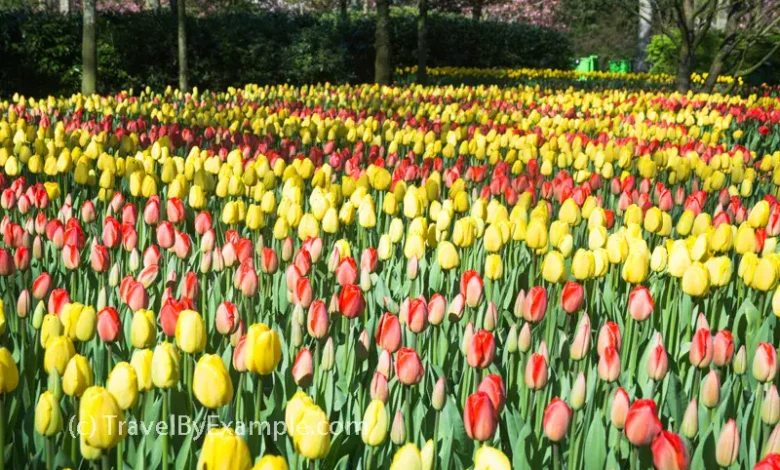
In tandem with its architectural and museum infrastructure, the Dutch landscape undergoes a dramatic seasonal transformation during the spring horticultural window. The agricultural production of flower bulbs—predominantly tulips, hyacinths, and daffodils—anchors a multi-million-euro export industry.
Lisse serves as the epicenter of this seasonal tourism. The region surrounding Lisse features extensive commercial bulb fields best explored via cycling infrastructure. Adjacent to these fields is the Keukenhof, widely recognized as the largest flower garden globally, displaying millions of bulbs across curated thematic pavilions and historical parkland.

Beyond Lisse, the province of Flevoland—specifically the Noordoostpolder region—contains the largest continuous area of tulip cultivation in the Netherlands. Agricultural tourism initiatives in Flevoland include specialized display gardens such as Pegasushof and Goldhoorn Gardens, alongside interactive picking farms like Hanneke’s Pluktuin. Similarly, the North Holland region, spanning the corridor between Alkmaar and Den Helder (including agricultural zones around Schagen, Anna Paulowna, and Julianadorp), offers extensive floral displays with significantly lower visitor density than the primary southern hubs. Agricultural authorities and local municipalities strictly regulate these zones, prohibiting unauthorized picking within commercial production fields to protect crop yields, while directing visitors to designated picking farms.