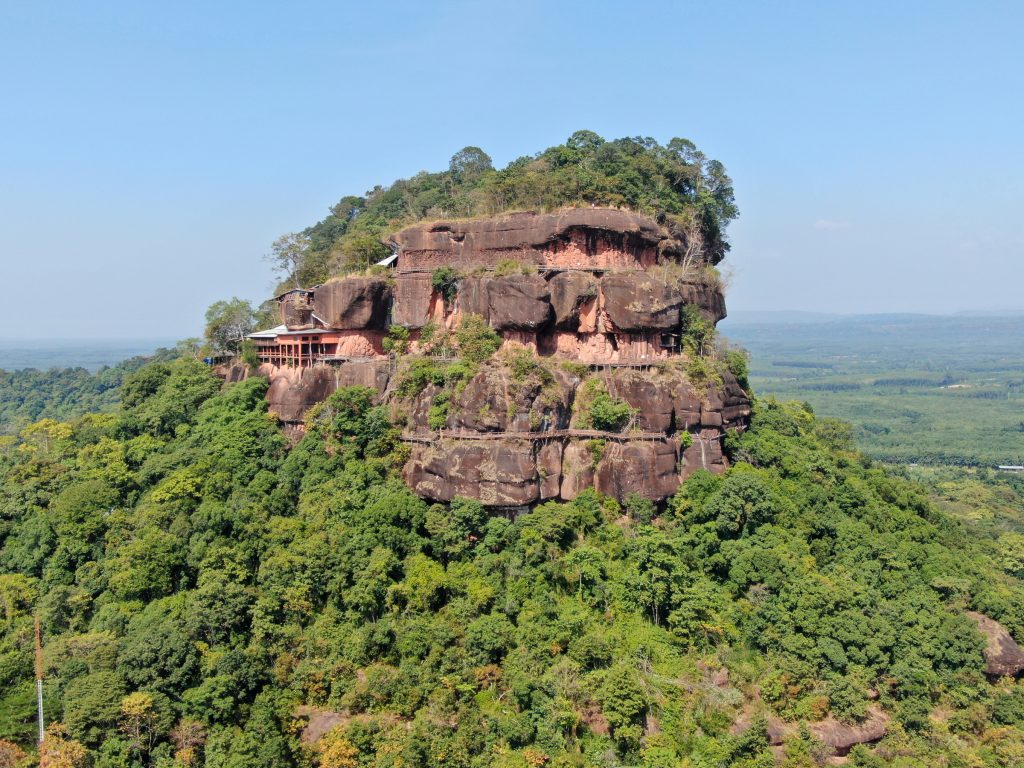
Nestled deep within the remote northeastern Isan region of Thailand, the province of Bueng Kan remains one of the country’s most undiscovered frontiers. Far removed from the bustling tourist corridors of Bangkok, Chiang Mai, and the southern islands, this tranquil province offers vast expanses of unspoiled nature, agricultural flatlands, and rural communities. Yet, rising sharply out of this otherwise flat topography is an arresting geological formation that defies the ordinary landscape: a massive, isolated sandstone monolith known locally as Phu Tok, meaning "lonely mountain." Clinging precariously to the sheer vertical faces of this 359-meter-high rock is Wat Jetiyakhiri, widely recognized by travelers and locals alike as Wat Phu Tok—arguably the most daring and architecturally astonishing temple complex in the Kingdom.
Main Facts and Geographic Overview
Wat Phu Tok is located approximately 30 minutes by road from Bueng Kan city, serving as a primary cultural and spiritual anchor for the lesser-visited province. Established as a sanctuary for intense spiritual practice, the temple is internationally celebrated for its intricate network of handmade wooden staircases, ladders, and cantilevered walkways that spiral up the red rock mountain.

The site is frequently compared to a smaller-scale version of Sri Lanka’s famous Sigiriya rock fortress due to its isolated rise from the surrounding terrain. However, while Sigiriya is primarily known as an ancient royal palace ruin, Wat Phu Tok functions as a living Buddhist monastery. The architectural layout of the temple is deeply symbolic, featuring seven distinct levels designed to physically and spiritually represent the seven stages of Buddhist enlightenment and meditation.
Chronology and Historical Origins

The history of Wat Phu Tok is inextricably linked to the late revered meditation master, Monk Luang Pu Juan. Decades ago, the rugged terrain, dense vegetation, and treacherous environment of the lonely mountain made it a virtually impassable wilderness teeming with wildlife, most notably dense populations of venomous snakes. For a forest monk seeking isolation, however, these very elements presented an ideal setting for ascetic meditation, combining natural solitude with an inherent physical danger that practitioners were required to overcome.
Recognizing the spiritual potential of the mountain, Luang Pu Juan spearheaded the monumental effort to establish a sanctuary. Without the aid of modern heavy machinery or industrial engineering, the monk, alongside local laborers and devoted followers, began constructing a series of wooden ladders and staircases anchored directly into the vertical stone. Over years of meticulous labor, these paths were expanded to circumnavigate the various tiers of the mountain, ultimately creating seven interconnected levels corresponding to the Buddhist path to liberation.

Tragedy struck the temple community when Luang Pu Juan tragically lost his life in a historic commercial airplane accident in 1980—a disaster that also claimed the lives of several other senior forest monks. Despite the loss of its visionary founder, the temple has been continuously maintained by subsequent generations of monks and local administrative bodies, preserving its structural integrity and its reputation as a sanctuary of profound spiritual reflection.
Architectural Layout and the Seven Levels of Ascent

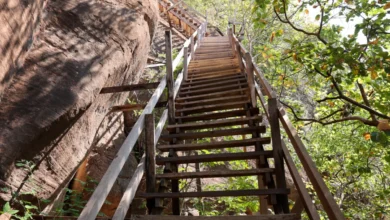
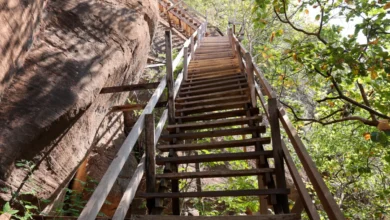
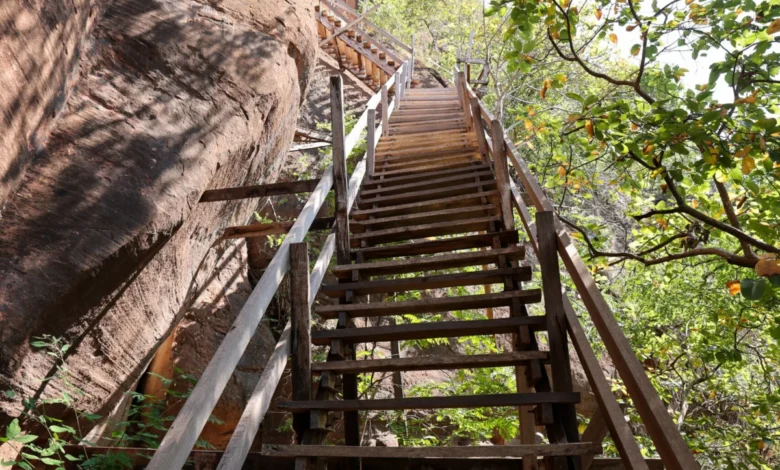
The pilgrimage up Wat Phu Tok begins at the base of the mountain, where visitors encounter a sprawling monastic park, a large lake, and the primary temple structures. The trail quickly transitions from standard earthen paths to steep wooden staircases that test the physical endurance and mental fortitude of visitors.
As climbers ascend through the lower tiers, the stairs progressively steepen, occasionally transforming into near-vertical ladders bolted against the stone face. While the construction utilizes local timber that may bow slightly underfoot, engineers and visitors alike note that the framework is robustly anchored and regularly inspected for safety.

Level 5: The Center of Monastic Life
Upon reaching the fifth level, the vertical ascent temporarily yields to a wider, ground-level plateau. This tier serves as the primary administrative and ceremonial hub of the monastery. Here, visitors find the principal ordination hall, alongside numerous smaller shrines, meditation cells, and resting areas utilized by the resident monks. Off the main trail of this level, a particularly rewarding detour leads adventurers along an elevated stone walkway connected by a small wooden bridge to an isolated rock shrine perched dramatically on the periphery of the mountain.
Level 6: The Apex of Thrills and Panoramas
Ascending another flight of steep stairs brings visitors to the sixth level, universally regarded as the architectural masterpiece and most thrilling feature of Wat Phu Tok. Approximately half of the sixth level’s circumference consists of wooden plank walkways cantilevered directly out from the vertical rock cliff, suspended hundreds of feet above the jungle canopy below.

Walking along these cliff-hanging pathways offers a potent mix of adrenaline and serenity. Though anchored securely into the sandstone, the sheer drops require absolute concentration from every visitor. Those who successfully navigate the path are rewarded with sweeping, uninterrupted panoramic views of the Mekong River basin, the borderlands of neighboring Laos, and the lush, rolling green canopy of Bueng Kan province. The prevailing mountain breezes and vast horizons create an ethereal atmosphere that justifies the physical exertion required to reach the summit.
Level 7: The Final Frontier and Ecological Warning
The seventh and final level marks the physical peak of the mountain. Accessible via a final, demanding climb, the top level diverges significantly from the engineered marvels of the lower tiers. There are no man-made walkways, elaborate shrines, or tourist infrastructure on the summit. Instead, it is an untamed, dense patch of forest.

Local authorities and temple custodians issue strict advisories regarding the seventh level due to its dense population of venomous snakes, urging travelers to approach strictly at their own risk and caution. While the summit offers additional vantage points for those who navigate the brush carefully, most visitors agree that the sixth level remains the definitive highlight of the Wat Phu Tok experience.
Broader Impact and Tourism Implications

From an economic and regional development perspective, attractions like Wat Phu Tok play a crucial role in promoting sustainable, off-the-beaten-path tourism in Thailand’s northeastern Isan region. Government tourism boards have increasingly sought to distribute tourist revenue away from saturated urban centers like Bangkok and major coastal resorts, directing travelers toward culturally rich, rural provinces such as Bueng Kan.
By offering a unique blend of architectural audacity, ecological immersion, and deep religious symbolism, Wat Phu Tok attracts a specific demographic of travelers—ranging from local pilgrims seeking religious merit to international adventurers looking for authentic, non-commercialized experiences. Despite its growing popularity on travel platforms, the site maintains a peaceful, reverent atmosphere, largely due to its remote geographic location and the active monastic community that governs visitor conduct.

Practical Guidance for Visitors
For those planning an excursion to Wat Phu Tok, preparation is essential. Travelers should wear appropriate footwear with strong traction, as the wooden planks and stone steps can become slick, particularly during the rainy season. Modest attire—covering shoulders and knees—is strictly required, as the site remains an active Buddhist monastery of immense local significance. Visitors prone to severe vertigo should carefully evaluate their comfort level before attempting the cantilevered walkways of the sixth level. Ultimately, a journey to Wat Phu Tok offers an unforgettable testament to human determination, architectural ingenuity, and spiritual devotion carved into the timeless rock of Thailand’s lonely mountain.