Exploring Wat Phu Tok: Thailand’s Architectural Wonder and Cliffside Temple in Bueng Kan Province

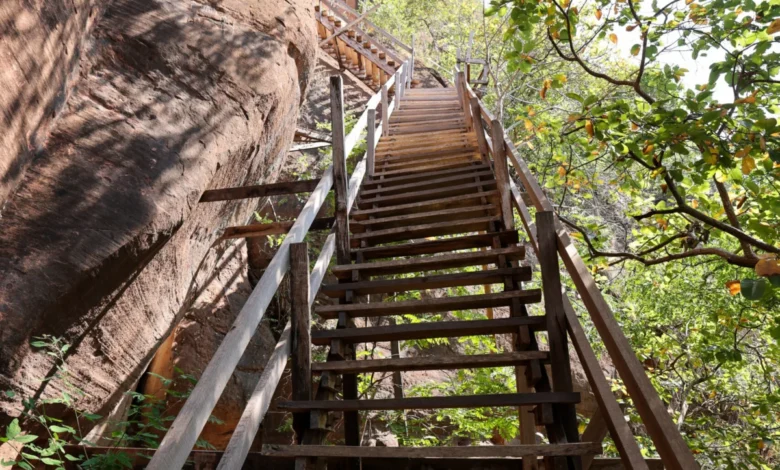
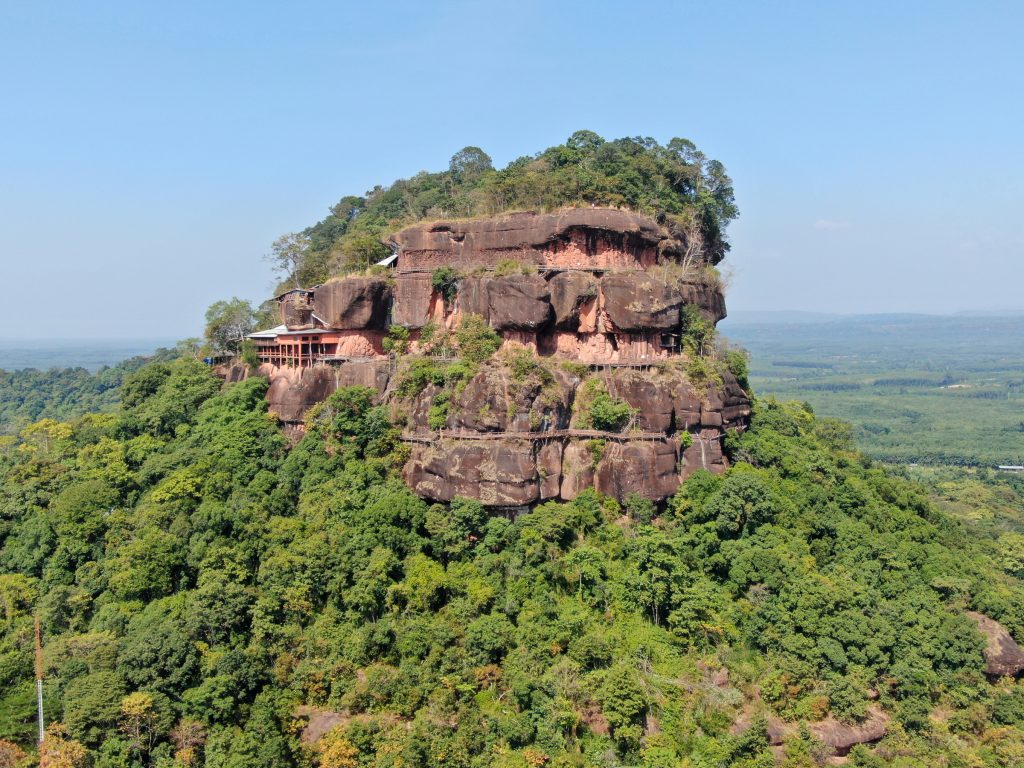
Nestled in the remote and verdant expanse of Bueng Kan province in northeastern Thailand’s Isan region lies Wat Jetiyakhiri, more commonly known as Wat Phu Tok. Rising 359 meters above the surrounding terrain, this solitary sandstone formation serves as the foundation for one of the most mechanically and architecturally ambitious religious sites in Southeast Asia. Often described as a smaller regional counterpart to Sri Lanka’s famed Sigiriya rock fortress, the temple is characterized by a network of hand-built wooden staircases, ladders, and cantilevered walkways clinging to vertical cliff faces. Designed not merely as a tourist attraction, the physical layout of the temple complex serves a profound spiritual purpose, symbolizing the seven stages of Buddhist enlightenment and meditation.
Historical Origins and Construction of the Mountain Temple
The history of Wat Phu Tok is inextricably linked to the vision of its founder, the revered ascetic monk Luang Pu Juan. Historically, the isolated and rugged terrain of the mountain was largely untouched, serving primarily as a natural habitat for diverse wildlife, including populations of venomous snakes. Recognizing the remote, tranquil environment as an ideal setting for ascetic Buddhist practice—where monks could confront and overcome elements of physical danger in pursuit of spiritual clarity—Luang Pu Juan established the site in the late 20th century.

Under his guidance, local laborers and monastic followers began the arduous task of constructing a pathway system using local timber. The master plan called for seven distinct vertical levels, mirroring the Buddhist theology of the seven tiers of spiritual awakening. The construction required anchoring wooden beams directly into the sheer sandstone cliffs, creating suspended pathways that allowed practitioners to navigate the treacherous verticality of the mountain. Although Luang Pu Juan tragically died in an aircraft accident before the complex could be fully finalized, his monumental vision has been meticulously maintained by succeeding generations of monks and local caretakers, preserving the architectural integrity of the site.
Geographical Context and Architectural Layout

Wat Phu Tok is situated approximately 30 minutes by road from Bueng Kan city, serving as a primary anchor for regional tourism in one of Thailand’s least commercially developed provinces. Upon arrival at the base of the mountain, visitors encounter a sprawling complex featuring a large lake, administrative parkland, and ample parking facilities before the formal ascent begins.
The architectural journey up the mountain is divided into seven distinct tiers, each offering unique structural and spiritual characteristics:

Levels One through Four: The Ascent and Transition
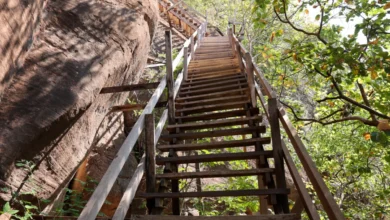
The initial approach begins via conventional dirt paths that rapidly transition into steep wooden staircases. While the stairs become increasingly vertical—at times resembling ladders—the structural engineering remains exceptionally stable, constructed with thick timber planks anchored firmly into the rock. These lower levels feature modest shrines and transitional spaces, functioning primarily as a physical and mental preparation phase for visitors before entering the more intense upper tiers.
Level Five: The Administrative and Ceremonial Core
Reaching the fifth level marks a significant shift in the topography of the trail. Unlike the narrow cliffside paths of the upper levels, the fifth tier comprises wider ground-level terrain. This level serves as the primary ceremonial hub of Wat Phu Tok, housing the largest ordination hall (ubosot) and numerous secondary shrines. It is also the access point for notable architectural detours, including a secondary elevated rock walkway that connects the main massif to an isolated cliffside prayer room via a suspended wooden bridge.

Level Six: The Suspended Cliffside Walkways
Widely regarded as the structural and experiential pinnacle of the complex, the sixth level consists of a continuous path that circles the perimeter of the mountain. Approximately half of this tier is anchored directly into vertical rock faces, featuring open-air wooden plank walkways suspended high above the ground. While the design provides panoramic vistas of the surrounding Mekong River basin and the unbroken canopy of Bueng Kan’s forests, it requires sustained concentration. The sheer drop-offs make this section both exhilarating and hazardous, prompting local authorities and guides to emphasize strict adherence to safety protocols.
Level Seven: The Summit and Ecological Sanctuary
The final tier represents the absolute peak of the 359-meter formation. Unlike the heavily engineered lower levels, the seventh tier contains no artificial wooden walkways or architectural shrines. Instead, it consists of the natural forested summit of the sandstone mountain. Historical records and local advisories caution that this uppermost level maintains a dense population of venomous snakes, leading to informal warnings that visitors ascend this final stage strictly at their own risk.

Tourism Impact and Regional Economic Implications
The presence of Wat Phu Tok has significant implications for the local economy of Bueng Kan, a province historically bypassed by the mass international tourism flows that characterize central and southern Thailand. As the region seeks to diversify its economic base through sustainable and nature-focused tourism, the temple acts as a critical catalyst for attracting domestic and international travelers interested in off-the-beaten-path destinations.

Local tourism authorities emphasize that the appeal of Bueng Kan lies precisely in its preservation of open space, natural biodiversity, and rural tranquility. However, the increasing popularity of Wat Phu Tok presents ongoing challenges regarding infrastructure management and environmental preservation. Maintaining aging timber structures anchored to high-altitude sandstone cliffs requires continuous engineering assessments, specialized maintenance labor, and financial allocation from both monastic donations and regional administrative budgets.
Safety Protocols and Visitor Guidelines

Due to the extreme verticality and remote nature of the site, safety remains a primary concern for site management. While structural engineers and maintenance crews routinely inspect the load-bearing capacity of the wooden beams and planking, the inherent risks associated with high-altitude cliffside traversal require strict behavioral guidelines from visitors.
Regional tourism boards recommend that individuals with severe vertigo, mobility impairments, or poor physical conditioning refrain from attempting the upper-tier ascents, particularly levels six and seven. Furthermore, visitors are advised to wear appropriate footwear with sufficient traction, maintain continuous focus on the pathway, and strictly adhere to posted boundaries. Respect for the monastic community and adherence to Buddhist sacred protocols are mandatory throughout the complex, ensuring that Wat Phu Tok maintains its dual identity as an active place of worship and a premier architectural landmark of northeastern Thailand.
Related posts: