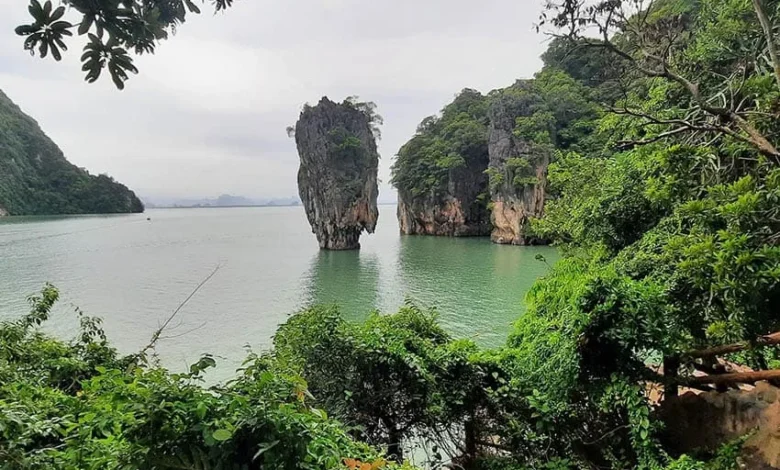
Every visitor who considers a maritime excursion from the shores of Phuket is invariably greeted by the same ubiquitous image: a solitary limestone pinnacle rising dramatically from emerald-green waters, universally recognized as James Bond Island. This geological marvel, formally known as Khao Phing Kan, is situated within the breathtaking expanse of Phang Nga Bay in southern Thailand and undoubtedly merits its global renown. Immortalized on the silver screen in the 1974 James Bond installment The Man with the Golden Gun, the site draws hundreds of thousands of international tourists annually, all eager to capture their own cinematic souvenir against the backdrop of the needle-like rock formation.
However, the glossy promotional photographs conceal a logistical reality that often dampens the visitor experience: the sheer volume of mass tourism. Standard commercial tour boats operate on rigid, synchronized timetables, resulting in a predictable bottleneck. Between the peak hours of eleven in the morning and two in the afternoon, the modest beach fronting the iconic rock routinely swells with hundreds of travelers, each allotted a fleeting forty-minute window before the next armada arrives.
Industry veterans and local maritime operators emphasize that Phang Nga Bay extends far beyond this singular, congested focal point. By reimagining the cadence of a day on the water, travelers can experience the majesty of the marine national park without the claustrophobia of mass tour groups. The solution does not require sailing farther afield; rather, it hinges on a strategic rearrangement of the traditional morning itinerary.
The Strategic Value of Private Charters
The primary differentiator between a standard group excursion and a private boat charter is not luxury, though luxury is frequently an option, but rather temporal autonomy. Purchasing a ticket for a joined tour consigns passengers to a rigid route and a fixed clock. Departure times, lunch schedules, and turnaround periods are codified long before travelers step foot on the pier.
Conversely, securing an entire vessel and its dedicated crew shifts control of the clock back to the traveler. A private charter enables departures synchronized with natural tidal movements rather than arbitrary bus schedules. This flexibility allows vessels to reach marquee destinations either ahead of the mainland tourist fleet or well after the crowds have dissipated. This subtle adjustment fundamentally transforms the character of the day, rendering the bay a tranquil sanctuary rather than a bustling tourist hub.

Navigating the Tides: The Enigma of Koh Hong
The destination that yields the highest return on this strategic timing is Koh Hong in Phang Nga Bay. In the Thai language, hong translates to room, a literal description of a geological phenomenon wherein centuries of marine erosion have hollowed out the interior of a limestone massif. The result is an enclosed, walled lagoon accessible exclusively via a single, low-lying water passage.
Visitors enter this hidden amphitheater in single-file canoes, navigating the subterranean tunnel. Once inside, the ambient noise of the bay dissipates entirely. Flanked by vertical limestone walls rising sixty to eighty meters into the sky, the acoustic environment is defined solely by the rhythmic drip of water and the gentle dip of paddles.
Yet, accessing this natural wonder is entirely contingent upon lunar cycles and tidal schedules. At high tide, the overhead clearance within the entrance tunnel is insufficient for safe passage, as the rock ceiling descends dangerously close to the water’s surface. Conversely, at low tide, the water level drops too low to float a canoe over the submerged obstacles.
Consequently, the viable entry window is restricted to a narrow band during mid-tide—approximately one hour on either side of the transition. Because this window shifts daily throughout the month, fixed-schedule commercial tours struggle to accommodate it. Standard tours arrive when their timetable dictates, frequently leaving canoes stacked unused on the upper decks if the tide is unfavorable. A private charter, by contrast, consults tide tables in advance, constructing the entire daily itinerary in reverse from the precise moment the lagoon becomes navigable.
Chronology of an Optimized Day on the Water
For seasoned maritime operators in Phuket, orchestrating a seamless day in Phang Nga Bay requires adherence to crowd dynamics and environmental conditions rather than scenic intuition. A meticulously planned nine-hour itinerary typically unfolds across four distinct phases.

The excursion generally commences at approximately 9:00 AM, with the vessel heading directly to James Bond Island (Khao Phing Kan). By arriving by 9:30 AM, private charters bypass the initial wave of high-speed catamarans and ferries departing from mainland piers, affording visitors a peaceful window to explore the site before the midday rush.
The second phase prioritizes Koh Hong, timed explicitly to coincide with the mid-tide opening of the inner lagoon. By syncing departure times with lunar charts, visitors enter the hidden chamber during its most serene hours.
Following the lagoon experience, the itinerary steers toward the marine sea caves of Koh Panak during the afternoon hours. By this time, commercial tour operators have turned their bows southward toward Phuket, leaving the cavernous, darkened water passages quiet and devoid of maritime traffic.
The concluding phase of the journey incorporates a leisurely cruise past the Naka Islands during the late afternoon, arriving back at the marina by 5:00 PM. Lunch is typically prepared fresh on board while the vessel rests at anchor, eliminating the need to crowd onto commercial beach canteens. Apart from the immutable schedule of the lagoon—which remains entirely dictated by the moon—every element of the day remains malleable to the desires of the charter group.
The Crucial Role of Marina Selection
An often-overlooked variable in planning a maritime excursion in Phuket is the geographical placement of the departure point. Phuket boasts four primary working marinas, and the choice of pier fundamentally dictates the operational radius and travel time of the voyage.
Koh Hong, for instance, lies approximately 18 kilometers from Ao Po Grand Marina, situated on the northeastern corner of the island. A departure from Ao Po requires a manageable transit time of roughly thirty minutes. In contrast, setting off from Chalong Pier in the deep south extends the distance to roughly 48 kilometers each way, nearly doubling transit times.

This geographical disparity explains why marine operators stationed at Ao Po can successfully package Koh Hong excursions as concise, four-to-five-hour half-day trips, whereas operators based in Chalong must market the exact same destination as a full-day commitment. For travelers journeying with small children or those operating on a constrained schedule, selecting the appropriate marina is far more critical than selecting the specific model of yacht.
Economic Realities and Charter Pricing
Navigating the pricing structure of marine charters in Thailand often presents a point of confusion for first-time visitors. Unlike standard boat tours that levy a per-person fee, private charters are universally priced on a per-vessel basis. This flat rate typically encompasses the rental of the boat, the services of a professional captain and crew, fuel allocated for the agreed-upon route, and freshly prepared onboard meals. National park conservation fees, however, are routinely assessed separately on a per-head basis upon entry.
For the 2026 and 2027 tourism seasons, standard baseline rates for a comprehensive, seven-to-nine-hour full-day charter begin at approximately 33,900 Thai Baht (roughly equivalent to 1,000 USD) for a compact speedboat accommodating up to six passengers. Upgrading to a 40-foot sailing catamaran capable of hosting fifteen guests starts at roughly 34,900 Baht, while a luxury 42-foot motor yacht designed for ten passengers generally commands around 39,900 Baht.
Specialized half-day private charters specifically targeting Koh Hong out of Ao Po Grand Marina start at approximately 50,000 Baht (roughly 1,500 USD) for a five-hour excursion on a power catamaran.
When evaluated on a per-person basis, the arithmetic of private charters shifts dramatically depending on group composition. Six individuals sharing a 50,000 Baht vessel incur an expense of approximately 250 USD per person—comparable to premium group packages but with vastly superior service and flexibility. For groups of twelve, the per-capita cost is halved. Conversely, couples traveling alone will invariably find private charters more expensive per head than joined tours, whereas cohesive groups of friends or extended families frequently find the private model both economically viable and vastly superior in quality.
Seasonal Variations and Weather Patterns

The Andaman Sea operates under distinct seasonal meteorological cycles. The official high season spans from November through April, characterized by calm seas and predictable sunshine. The low season runs from May through October, bringing monsoon rains and occasional wind swells to Phuket’s exposed western coastline.
However, Phang Nga Bay occupies a uniquely sheltered geographical niche. Shielded from the open ocean by the landmass of Phuket and the mainland peninsula, the bay remains remarkably flat and navigable even during the height of the low-season monsoon. This geographic protection allows maritime operators to conduct charters year-round, offering an alternative to west-coast excursions that are frequently suspended due to hazardous sea conditions.
Implications for Travelers and Local Tourism
The operational dynamics of Phang Nga Bay underscore a broader evolution within the Southeast Asian tourism landscape. As global travel rebounds to pre-pandemic volumes, destinations that rely heavily on single iconic landmarks face acute infrastructure stress. The bottleneck at James Bond Island serves as a classic case study in the perils of overtourism driven by cinematic nostalgia.
Industry analysts suggest that the growing preference for private charters and localized maritime logistics reflects a broader consumer shift toward experiential, highly personalized travel. By decoupling from rigid mass-tourism schedules, modern travelers not only enhance their personal enjoyment but also distribute economic activity more evenly across secondary and tertiary regional attractions—such as the hidden lagoons of Koh Hong and the tranquil sea caves of Koh Panak.
Ultimately, the iconic limestone pinnacle featured in countless travel brochures remains a mandatory sight for anyone visiting southern Thailand for the first time. Yet, as experienced local operators continually advise, the true majesty of Phang Nga Bay lies not in the static postcard view, but in the dynamic, tide-governed labyrinth of islands that wait just beyond the horizon.