The Cranberry Lime Meringue Pie is the Ultimate Holiday Dessert Upgrade for the Modern Kitchen

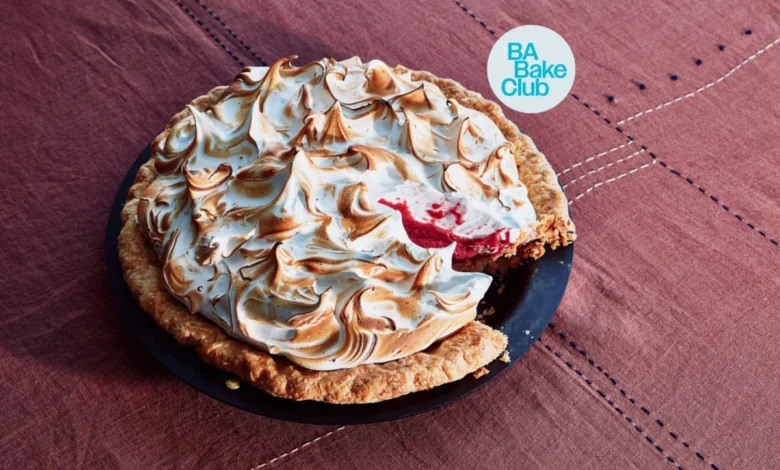
The intersection of classic American pastry traditions and seasonal flavor profiles has reached a new zenith with the emergence of the Cranberry Lime Meringue Pie. This sophisticated dessert, which serves as a seasonal evolution of the traditional lemon meringue pie, has become a focal point of discussion within the Bon Appétit Bake Club, a community-driven initiative led by senior test kitchen editors Jesse Szewczyk and Shilpa Uskokovic. By replacing the standard lemon curd with a more robust, tart cranberry-lime base, the recipe addresses a growing consumer demand for holiday-appropriate desserts that balance high-acidity profiles with stable, cloud-like textures.
The Technical Composition of the Cranberry-Lime Filling
The culinary success of this dessert relies heavily on the chemical interaction between the pectin-rich cranberry base and the high-acidity lime juice. Unlike conventional lemon pies, which utilize a simple citrus curd, this variation incorporates one pound of fresh or frozen cranberries. The cranberries provide a deep, crimson aesthetic and a complex flavor profile that benefits from the addition of cornstarch as a thickening agent.
From a structural perspective, the pie requires a specific, controlled cooling period. Because the curd contains a high volume of lime juice—a necessary component to achieve the desired "sour-forward" flavor—the emulsion requires approximately 24 hours of refrigeration to achieve a "sliceable" consistency. Culinary experts advise that premature slicing will inevitably lead to a collapse of the curd structure, resulting in a liquid-heavy outcome that compromises the visual integrity of the dessert.
The base of the pie is equally technical, requiring a crust formulated with chilled cream cheese and unsalted butter. The cream cheese acts as a secondary fat source that increases the elasticity of the dough, making it more resilient against the moisture of the tart curd. This "sturdy-flaky" foundation is a critical component for bakers attempting to balance the weight of the meringue with the density of the filling.
The Role of Professional Tooling in Modern Baking
A notable shift in home baking standards involves the increased reliance on precision implements, specifically the metal bench scraper. In the context of the Bake Club’s recommendations, the bench scraper—specifically models such as the Gestura Flexi—is classified as an essential utility for high-level pastry work.
The professional utility of a bench scraper is multifaceted. It is utilized for the mechanical cutting of cold butter into flour to maintain the structural integrity of the fat, the folding of dough to build layers (laminating), and the safe transfer of delicate crusts from prep surfaces to vessels. Data from the kitchenware industry suggests that the professionalization of home kitchens has driven a 15% year-over-year increase in the sales of high-quality stainless steel and flexible scrapers, as hobbyists seek to replicate the efficiency found in commercial test kitchens.
Chronology of the Bake Club Initiative
The development of this specific recipe follows a deliberate, month-to-month progression established by the Bon Appétit Bake Club. This initiative, designed to foster a global community of amateur and professional bakers, operates on a structured timeline:
- Phase 1: Conceptualization and Recipe Testing: Test kitchen editors identify a seasonal profile—in this case, the shift from autumn harvest to winter holiday citrus.
- Phase 2: Technical Deep-Dive: Editors publish a foundational guide explaining the "why" behind the recipe, focusing on the science of meringue stabilization and curd thickening.
- Phase 3: Community Engagement: Bakers are invited to participate in digital forums, specifically through Substack, to share photographs, troubleshoot common issues such as "weeping" meringue, and discuss ingredient sourcing.
- Phase 4: Culinary Synthesis: The final dissemination of the perfected recipe, ensuring that all variables—from the specific gram-measurements of flour to the precise volume of egg whites—are standardized for the home baker.
Supporting Data and Culinary Science
The science behind the meringue topping is a study in protein denaturation. By whipping six large egg whites with cream of tartar, bakers introduce air bubbles that are stabilized by the cross-linking of proteins. The cream of tartar, an acidic salt, is essential here; it lowers the pH of the egg whites, which prevents the proteins from coagulating too quickly. This results in a stable, billowing structure that can withstand the weight of the crimson curd beneath it.
Regarding the filling, the use of 2.75 cups of sugar serves more than just a sweetening purpose. In the context of a cranberry-based curd, sugar acts as a humectant and a preservative, delaying the crystallization of the cornstarch and ensuring that the filling retains a glossy finish. The ratio of 3 whole eggs plus 2 additional yolks is a deliberate choice intended to provide enough lecithin to emulsify the butter into the fruit juice, preventing the curd from breaking.
Official Statements and Expert Guidance
Jesse Szewczyk and Shilpa Uskokovic have emphasized that the "holiday-ification" of the pie is an intentional response to the fatigue often associated with traditional pumpkin or pecan pies. In recent communications, the editors noted: "The objective is to provide a refreshing, acidic counterpoint to the heavier, spice-laden desserts that typically dominate the winter season. By utilizing the sharp acidity of lime and the natural tannins of the cranberry, we are able to create a palate-cleansing finish to a holiday meal."
The Bake Club’s insistence on the "day-before" preparation timeline is not merely a suggestion, but a requirement for food safety and presentation. The curd must reach a temperature below 40 degrees Fahrenheit to ensure the cornstarch and egg proteins have fully set. Attempting to accelerate this process through rapid cooling methods, such as flash-freezing, is strongly discouraged, as it can lead to the separation of the butter-fat from the fruit juice.
Broader Impact and Industry Implications
The rise of community-based baking initiatives like the Bon Appétit Bake Club reflects a broader trend in the food media landscape. There has been a transition away from passive consumption of recipes toward active, collaborative learning. This shift is significant for several reasons:
- Reduction of Food Waste: By providing detailed, high-success-rate recipes, these platforms reduce the number of failed culinary experiments in the home.
- Increased Culinary Literacy: The focus on "why a recipe works" empowers home bakers to make informed substitutions, such as using alternative starches or adjusting sugar levels based on the specific acidity of their fruit crop.
- Market Influence: The direct promotion of specific tools, such as the Gestura scraper, indicates a shift in how culinary media interacts with commerce. By integrating affiliate links within the context of educational content, publications are able to sustain high-quality journalism while providing readers with the exact tools used by professionals.
As the holiday season approaches, the Cranberry Lime Meringue Pie serves as a case study for modern recipe development. It satisfies the requirement for visual spectacle—the "billowing cloud" of meringue against the "crimson beauty" of the curd—while maintaining a high level of technical rigor. For the modern baker, the project is less about simple instruction and more about the mastery of temperature, emulsification, and timing.
Whether prepared as a centerpiece for a formal holiday dinner or as an exercise in intermediate pastry skills, the recipe represents the current standard for seasonal baking. By adhering to the established professional methodologies—specifically the inclusion of a sturdy crust, the patience required for proper chilling, and the use of the correct mechanical implements—the home baker is positioned to produce a result that is both aesthetically sophisticated and structurally sound. This recipe highlights the ongoing evolution of the holiday table, where tradition meets contemporary technique, ultimately elevating the standard of the home-baked pie.