Echoes of the Steppe: Conservationists Fight to Preserve the Ancient Migration Routes of Central Asia’s Saiga Antelope

The rugged expanses of the Eurasian steppe, stretching from the Caucasus Mountains to the edges of Mongolia, have long served as a testament to deep evolutionary history. Among the few megafauna survivors of the Late Pleistocene epoch are the saiga antelope (Saiga tatarica), distinctively adapted ungulates that once shared a landscape with woolly mammoths and saber-toothed cats. Today, these resilient nomads face an increasingly fractured world. Industrial development, cross-border infrastructure, and agricultural expansion threaten to sever migration corridors that have existed for millennia. Recent field audits conducted by conservation organizations in western Kazakhstan highlight the ongoing struggle to safeguard these ancient pathways, shedding light on the broader implications of habitat fragmentation for nomadic wildlife.
Historical Resilience and Evolution of the Saiga
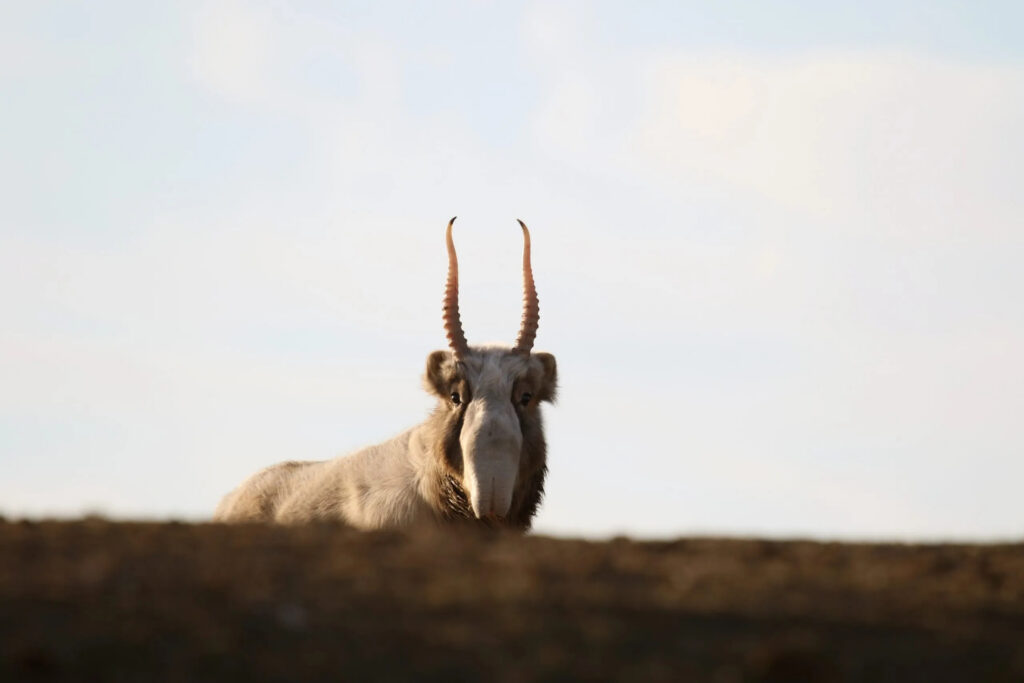
The saiga antelope is an evolutionary marvel, uniquely equipped for the extreme continental climate of Central Asia. Characterized by its flexible, elongated snout, the species uses its nasal apparatus to filter out choking dust during arid summer months and to warm sub-zero winter air before it reaches the lungs. Historically, these physical adaptations allowed saigas to undertake massive seasonal migrations across vast, treeless plains.
For millennia, the movements of saiga herds served as a natural compass for human populations. Early nomadic tribes and merchants navigating the treacherous overland routes of the proto-Silk Road relied on the presence of saigas to locate reliable water sources and passable terrain. Seventh-century BCE cave paintings discovered throughout the region depict the antelope with mythical reverence, honoring their ability to traverse an environment that routinely proved fatal to unprepared travelers.
However, the twentieth century brought unprecedented disruptions to this ancient equilibrium. The rise of the Soviet Union initiated mandatory sedentarization policies, forcing traditionally nomadic human populations into agricultural settlements and effectively ending centuries of seasonal movement across the steppe. While human societies transitioned toward permanent urban and rural settlements, the saigas continued their nomadic existence, maintaining a lifestyle dictated by seasonal shifts in vegetation and climate.
Infrastructure and the Fragmentation of Migration Corridors
In contemporary times, the primary threat to the survival of the saiga antelope is not climate or natural predation, but anthropogenic landscape fragmentation. As Kazakhstan and neighboring nations modernize their economies, the construction of linear infrastructure—including highways, electrified railways, and border fencing—has systematically sliced through traditional migration routes.
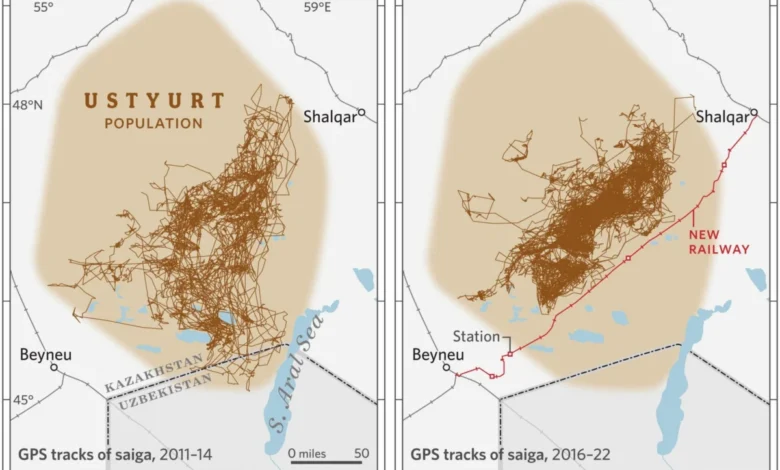
Data compiled by conservation groups, such as the Association for the Conservation of Biodiversity of Kazakhstan (ACBK), vividly illustrate this ecological bottleneck. GPS-collaring initiatives reveal that populations once capable of trekking hundreds of miles across international borders are now abruptly halted by physical barriers. For instance, tracking data from 2014 documents a distinct saiga population that routinely wintered in the warmer pastures of Uzbekistan, only to have its traditional path severed by the construction of a new railway line. Post-construction telemetry data shows individual animals trapped on the northern side of the tracks, unable to access historical feeding grounds to the south, while the ecological knowledge embedded within the herd risks being permanently lost.
Conservation scientists emphasize that spatial knowledge among saigas is culturally transmitted from older generations to the young through observation and shared migration. When physical barriers abruptly block these routes, the collective memory of the herd is disrupted, leading to behavioral disorientation and localized population declines.
Collaborative Conservation and Cross-Border Mitigation
In response to these mounting pressures, international conservation bodies and government agencies have initiated targeted mitigation strategies to restore connectivity across the Eurasian steppe. Organizations like ACBK have collaborated closely with the government of Kazakhstan to establish new wildlife sanctuaries informed by empirical tracking data. Furthermore, infrastructure adjustments are being actively implemented to reduce mortality and restore passage.
To address the barrier effects of transportation networks, engineers and conservationists have designed specialized saiga-friendly crossings. These structures feature gently sloping dirt ramps that match the elevation of railway lines, creating the illusion of a continuous landscape. Strategic placement of cattle-guard fencing well away from these intersections prevents direct collisions between fast-moving trains and skittish ungulates.
International cooperation has proven equally vital along political boundaries. In partnership with authorities in Uzbekistan, conservation groups have modified rigid barbed-wire border fortifications into wildlife-permeable barriers. By replacing solid fencing with X-shaped barricades that deter motorized vehicles while leaving sufficient ground clearance for saigas, authorities have successfully re-established access to critical southern ranges.
Broader Environmental and Cultural Implications
The ongoing efforts to protect the saiga antelope transcend localized species conservation; they represent a critical test for landscape-scale biodiversity management in rapidly developing regions. The degradation of the Eurasian steppe mirrors ecological challenges observed globally, where the expansion of linear infrastructure compromises ecosystem integrity and migratory processes.
Analyses of past population crashes—such as the devastating epizootic event in 2015 that wiped out over 60 percent of the global saiga population due to bacterial infections exacerbated by anomalous weather—underscore the fragility of even recovering wildlife numbers. Ensuring that herds maintain access to expansive, interconnected ranges is viewed by biologists as the most effective insurance policy against localized environmental catastrophes.
As conservationists, researchers, and government officials continue to adapt management strategies to a changing landscape, the fate of the saiga remains intertwined with the cultural and ecological identity of Central Asia. Preserving the integrity of these ancient migration routes ensures that the steppe retains not only a vital ecological keystone species, but also a living link to the deep history of human and animal mobility across the Eurasian continent.