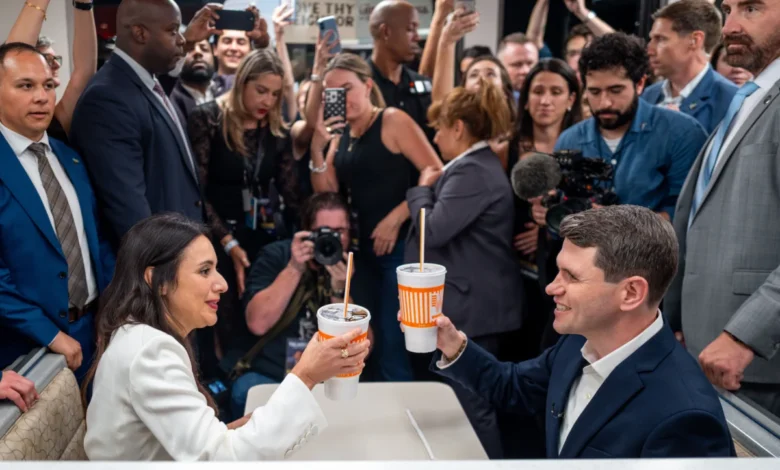
Late Tuesday night, in the fluorescent glow of an Austin-area Whataburger, Senator-elect James Talarico and Governor-elect Gina Hinojosa marked a seismic shift in American politics. Surrounded by the iconic orange-and-white striped decor that has defined Texas roadside culture since 1950, the two newly minted Democratic leaders clinked plastic cups, celebrating victories that effectively ended more than three decades of Republican hegemony in the state’s highest offices.
The images of Talarico and Hinojosa, sharing a modest fast-food meal in the wake of their triumph, served as a potent visual shorthand for their populist campaigns. Having toppled entrenched political figures and navigated a bruising, hyper-partisan cycle, the pair opted for a quintessential Texas tradition over the traditional pageantry of victory galas. This moment of quiet, caloric normalcy stood in stark contrast to the intensity of the campaigns they led—races characterized by aggressive debate over the state’s economic future, energy policy, and the influence of out-of-state capital in Texas politics.
A Chronology of a Political Earthquake
The Tuesday night results were the culmination of an eighteen-month electoral odyssey that saw Democrats shift their strategy from statewide mobilization to targeted, localized grassroots efforts.
In early 2026, the political landscape in Texas appeared firmly in the hands of the Republican incumbent class. Governor Greg Abbott entered his reelection bid with a massive war chest and the full backing of national GOP infrastructure. However, by mid-summer, a series of controversies—ranging from allegations of corruption regarding state data center contracts to a perceived detachment from the rising cost of living—began to erode his base.
Simultaneously, the Senate race between James Talarico and incumbent Ken Paxton became a proxy battle for the soul of Texas. Paxton, beset by long-standing legal challenges and ethical scrutiny, found himself on the defensive as Talarico pivoted his messaging toward affordability, transparency, and a rejection of billionaire influence. The campaign reached a fever pitch in October, when national figures, including former President Donald Trump, weighed in, attempting to cast Talarico as an out-of-touch coastal liberal.
The final stretch of the election saw record-breaking early voting turnout, particularly in urban centers like Dallas, Houston, and Austin, as well as critical shifts in suburban counties that had historically leaned Republican. When the polls closed, the “blue wave” that many pundits had predicted as a possibility finally crested, resulting in the most significant Democratic victory in the state since the early 1990s.
The Anatomy of the Campaign: From Barbecue to Ballots
The victory for Talarico and Hinojosa was not merely a matter of party affiliation; it was a success of narrative framing. Talarico, in particular, faced a unique set of obstacles. Opponents attempted to define him through a series of "meat-and-masculinity" attacks, questioning his commitment to Texas traditions by alleging he was a vegan. The political discourse hit a bizarre low when national surrogates suggested that Talarico’s dietary preferences were a disqualifying trait for a Texas leader.
By engaging in a public, visible celebration at Whataburger—a cathedral of beef, bacon, and breakfast taquitos—Talarico effectively neutralized these critiques. The move was calculated to demonstrate that he was not an interloper, but a Texan who understood the cultural currency of the state’s culinary institutions.
This strategy was bolstered by the campaign’s focus on "affordability politics." In a cycle where inflation remained a primary concern for the average voter, the ability to frame policy around the cost of a double-burger Whatameal—which remains accessible for under $15—provided a relatable, tangible metric for economic stability. This resonated far more effectively with the electorate than the high-dollar, billionaire-backed television spots that dominated the airwaves for the Republican ticket.
Supporting Data: The Demographic Shift
The electoral data indicates that the shift was driven by a coalition of younger voters, suburban women, and a significant surge in Hispanic turnout. Hinojosa, who made history as the first Latina elected Governor of Texas, anchored her platform on addressing the state’s infrastructure and the regulation of massive, energy-intensive data centers that have strained local power grids.
According to preliminary exit polling:
- Suburban Realignment: The Democratic ticket saw a 12% swing in suburban precincts compared to the 2022 midterm elections.
- Youth Voter Participation: Turnout among voters aged 18–29 increased by nearly 18% compared to previous cycles, providing a decisive margin in key districts.
- The "Billionaire Factor": Voters consistently identified "outside influence" and "wealthy donor impact" as top-three concerns in the Senate race, a sentiment that Talarico leveraged to distance himself from Paxton’s well-funded apparatus.
Official Responses and the Road Ahead
Following the certification of the results, reaction from the political establishment has been mixed. Supporters of the new administration see the victory as a mandate to overhaul the state’s approach to energy, education, and healthcare. Conversely, the Republican Party of Texas has signaled a period of internal reassessment.
"We are disappointed in the outcome, but we recognize that the electorate has demanded a new direction," a representative for the outgoing administration stated on Wednesday morning. "The party will focus on rebuilding our grassroots outreach to ensure that we remain the standard-bearers for Texas values in the next cycle."
For the incoming Governor and Senator, the challenge now shifts from campaigning to governing. With a legislature that remains deeply divided, Hinojosa and Talarico will need to bridge the gap between their progressive platform and the realities of a state that remains socially and economically diverse.
Broader Implications for National Politics
The success of the Texas Democratic ticket suggests a broader recalibration of national political strategy. By moving away from purely ideological debates and focusing on the intersection of culture, affordability, and regional identity, Democrats have found a blueprint that could be applied in other traditionally "red" or "purple" states.
Moreover, the result in Texas serves as a warning to national Republican strategists that the influence of high-profile donors and the reliance on culture-war distractions may have reached a point of diminishing returns. The electorate’s preference for localized, relatable leadership—even if that leadership is part of a national party movement—indicates a growing skepticism toward centralized, top-down political messaging.
As Talarico and Hinojosa prepare to take their oaths of office, the imagery of that late-night Whataburger meal will likely remain an enduring symbol of this election cycle. It serves as a reminder that in Texas, politics is never truly separated from the daily life of its citizens. Whether it is the price of a meal, the reliability of the power grid, or the cultural symbols that residents hold dear, the new leadership in Austin will be judged not by their rhetoric, but by their ability to deliver on the fundamental promises that brought them to power.
The transition period will be closely watched by political analysts and constituents alike. With major policy decisions looming—specifically regarding the future of the state’s data center regulations and the potential expansion of social services—the honeymoon period for the new administration is expected to be short. However, for one night in Austin, the political class allowed itself a moment of simplicity, a brief pause before the work of governance begins in earnest. The "blue wave" has arrived in the heart of the Lone Star State, and the political landscape will never be the same.