Demystifying Camera Aperture: Professional Photographer Brenda Bergreen Breaks Down Manual Mode Fundamentals for Modern Creators

The terminology surrounding photographic aperture—ranging from fast glass and wide open to bokeh and stopping down—has long presented a steep learning curve for beginner and intermediate photographers transitioning away from automatic settings. This dense lexicon frequently transforms a fundamental photographic control into an intimidating mathematical equation. However, seasoned commercial photographers and industry educators are increasingly emphasizing that once creators understand the two primary variables altered by aperture adjustments, selecting an f-stop shifts from an arbitrary guesswork exercise into a deliberate, creative decision.
Brenda Bergreen, an established professional photographer operating alongside her husband as part of The Bergreens creative team, has recently released an instructional framework designed to strip away unnecessary technical jargon. By focusing strictly on depth of field and light gathering capabilities, Bergreen aims to demystify manual shooting for modern content creators, vloggers, and hobbyists stepping into interchangeable-lens photography.
Stripping Away Technical Jargon for Practical Application
In contemporary photographic education, instructional materials often bog down learners with complex optical physics, such as diffraction limits, sensor micro-lenses, and the physical intricacies of multi-blade diaphragm constructions. While these metrics hold significant value in high-end optical engineering and specialized scientific imaging, they frequently paralyze beginner photographers who are simply trying to capture a sharp portrait or a compelling landscape.
Bergreen’s pedagogical approach deliberately bypasses these secondary technical topics to maintain an undivided focus on practical field application. By isolating the two core effects of aperture—controlling how much of the scene remains in sharp focus and regulating the physical volume of light striking the image sensor—photographers can immediately visualize the consequences of turning their camera’s command dials.
This functional perspective aligns with broader shifts in digital photography education over the past decade. As mirrorless camera systems and advanced smartphone computational photography democratize content creation, educational resources have increasingly pivoted toward intuitive, visual learning models rather than rote memorization of optical formulas.
Understanding Depth of Field Through Practical Visualization
To explain depth of field—the zone of acceptable sharpness within a photo that extends near and far from the plane of critical focus—Bergreen utilizes a relatable real-world scenario: photographing children participating in youth sports from the sidelines. In such dynamic environments, a photographer often wants to isolate a specific child while allowing distracting elements, such as opposing players closer to the lens or spectators positioned across the field, to dissolve into a soft, unblustery blur.
To translate this optical phenomenon into a visceral experience for learners, Bergreen recommends a simple physiological exercise: holding one thumb close to the face while extending the other arm outward. By alternating focus between the near thumb and the far thumb, the human eye immediately perceives how depth of field operates biologically. Once a photographer physically experiences this selective focus, the abstract numbers associated with f-stops acquire tangible meaning.
Furthermore, Bergreen addresses a pervasive industry misconception: the belief that achieving a shallow depth of field and pronounced background blur strictly requires purchasing expensive, ultra-fast prime lenses with maximum apertures of f/1.2 or f/1.4. While such lenses certainly offer extreme background separation, aperture is merely one component of a multi-variable equation.
As Bergreen demonstrates using equipment such as the Sony FE 70-200mm f/4 Macro G OSS II lens, professional subject separation is entirely attainable at f/4. Background blur is fundamentally governed by four distinct factors:
- The physical aperture setting (f-number).
- The distance between the camera and the primary subject.
- The distance between the subject and the background.
- The focal length of the lens being utilized.
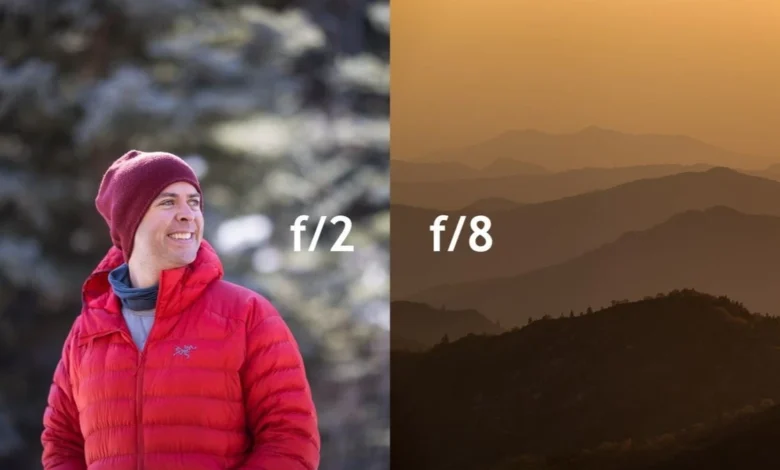
By leveraging longer focal lengths and managing working distances, photographers utilizing standard zoom lenses or moderate variable-aperture optics can achieve artistic subject isolation without investing heavily in specialized prime lenses. The governing rule remains consistent: lower f-numbers produce a shallower depth of field, whereas higher f-numbers yield a deeper depth of field that keeps more of the composition in focus.
The Mechanics of Light and Exposure Mathematics
Beyond controlling focus planes, the aperture mechanism physically regulates the quantity of light that passes through the lens barrel and reaches the camera’s digital sensor or film plane. To conceptualize this light-gathering function, Bergreen draws a direct biological parallel to the human eye. When an individual steps into a dark environment and looks into a mirror, the pupils automatically dilate, expanding to permit the maximum possible light entry.
Camera lenses operate on an identical principle, though the nomenclature can initially confuse novices. An aperture setting of f/1.4 features a physically massive internal opening, despite "1.4" appearing mathematically smaller than "16." This counterintuitive convention occurs because the f-number is formally expressed as a fractional ratio derived from the lens’s focal length divided by the effective diameter of the entrance pupil.
Bergreen streamlines this mathematical reality into an intuitive mnemonic pairing:
- Small f-number equals a big physical opening, resulting in more light entering the camera.
- Large f-number equals a small physical opening, resulting in less light entering the camera.
In professional terminology, the action of "opening up" a lens refers to adjusting the setting toward a lower f-number (such as moving from f/4 to f/1.8), while reaching the absolute limit of the lens’s physical capacity is known as shooting "wide open." Conversely, "stopping down" describes the process of transitioning toward higher f-numbers with smaller physical openings, such as f/16 or f/22.
The practical implications of these light adjustments are profound, particularly in low-light scenarios. Lenses capable of achieving exceptionally wide apertures are colloquially designated as "fast lenses" because the additional light they permit allows for faster shutter speeds. For example, maintaining a constant environmental illumination level, capturing an image at f/1.4 might yield a necessary shutter speed of 1/100th of a second. Stopping the lens down to f/2.8 reduces the light intake by precisely two stops, forcing the shutter speed to drop to approximately 1/25th of a second.
A shutter speed of 1/25th of a second introduces a severe operational risk of motion blur caused by hand tremors or subject movement. When photographers face this limitation, their remaining compensation options involve raising the camera’s ISO sensitivity—which introduces visible digital noise and degrades image clarity—or further slowing the shutter. Consequently, possessing a fast aperture provides vital operational latitude, allowing creators to keep both ISO noise and motion blur under strict control.
Practical Subject-Based Guidelines and Starting Points
To assist photographers transitioning away from automated shooting modes, Bergreen outlines empirical baseline settings categorized by common photographic genres. While these metrics serve as flexible starting points rather than rigid dogmatic rules, they provide reliable parameters for those navigating manual exposure:
- Portraits: When the primary objective is achieving a dreamy, isolated subject with a soft, distraction-free background, photographers frequently initiate their settings between f/1.8 and f/2.8.
- Group Portraits: Capturing multiple individuals requires careful planning, as subjects standing at varying distances from the camera plane can easily fall outside a hyper-shallow depth of field. For standard group shots, starting between f/4 and f/5.6 ensures all participants remain acceptably sharp, subject to the specific geometric arrangement of the group.
- Landscapes: When maximum detail and edge-to-edge sharpness across the entire vista are paramount, landscapes are typically initiated around f/8. However, photographers may intentionally open their aperture wider to create a deliberately soft foreground frame layer, or conversely, stop down further to f/16 or f/22 when specific creative effects—such as distinct sun stars emanating from point light sources—are desired.
Bergreen’s overarching philosophy reduces aperture decision-making to a streamlined binary inquiry: What elements within the frame must remain in sharp focus, and how much ambient light is available in the environment?
Recommended Field Exercises for Skill Mastery
To solidify these theoretical concepts into practical muscle memory, Bergreen advocates for a controlled comparative exercise. Photographers are encouraged to mount their camera on a stable tripod to eliminate framing variations, select a stationary subject, and capture four distinct frames at specific aperture milestones:
- The widest available aperture of the lens.
- f/4.
- f/8.
- f/16.
By maintaining a fixed physical position and analyzing the resulting images side-by-side, creators can directly observe how the background transforms across different f-stops. Furthermore, for those operating fully within manual exposure mode, this exercise highlights the compulsory compensation adjustments required in shutter speed or ISO to maintain a consistent exposure value across all four frames.
Broader Industry Implications and Educational Evolution
The release of simplified instructional content addressing foundational photographic principles reflects a broader, ongoing transformation in how visual media skills are disseminated. As barrier-to-entry costs for high-quality digital imaging equipment continue to decline, the demand for accessible, jargon-free technical education has surged.
Industry analysts note that traditional academic photography programs have historically front-loaded complex optical theory, a method that frequently alienates casual learners and recreational enthusiasts. By contrast, modern digital creators and online educators favor pragmatic, results-oriented frameworks that prioritize creative agency over technical minutiae.
By stripping away the intimidation factor associated with manual camera operations, educational initiatives like Bergreen’s empower a wider demographic of creators to harness the full creative potential of their gear. Ultimately, mastering aperture transforms a daunting mechanical setting into an expressive artistic tool, enabling photographers to deliberately shape light, direct viewer attention, and execute their unique creative vision with confidence.
Related posts: